

You served as the deputy governor of RBI for nine years from 1982 to 1991 under four governors before becoming governor yourself. Why do you think the external situation deteriorated even before the Iraq war?
What are your memories of the two consecutive rupee devaluations in July 1991. Did the RBI recommend that to the government or was it the other way around?
After the new government took over power, we had to take certain urgent measures first to tackle the BoP situation. This meant a substantial devaluation of the rupee. In fact, even earlier on a day-to-day basis, the RBI had reduced the value of the rupee, but the crisis demanded more action. There were several meetings in which both the government and RBI participated. On the need for devaluation, there was no difference of opinion between the government and RBI. The decision to devalue was taken in a joint meeting. It was also discussed with the President.
Prime Minister P V Narasimha Rao had second thoughts after the July 1 devaluation and wanted to stop the second devaluation. Apparently then finance minister Manmohan Singh tried to reach you but couldn’t. Do you think history would have taken a different course if you had not gone ahead with the second devaluation?
The decision on devaluation is usually announced by the government. In 1991, it was done differently. The RBI was daily announcing the value of the rupee those days (I was in charge of it). At the meeting on devaluation, it was decided that this time the RBI would announce the decision as part of its daily announcement. Since the level of devaluation was huge, it was also decided to do it in two stages. Much of the help that we were expecting from outside would have taken a beating if we had not gone through with the second stage of devaluation. It was a measure of our determination to do the right thing. Failure to go through with the second stage would have sent the wrong message.
At that time, did you also brief PM Rao or was your communication channel always through Manmohan Singh?
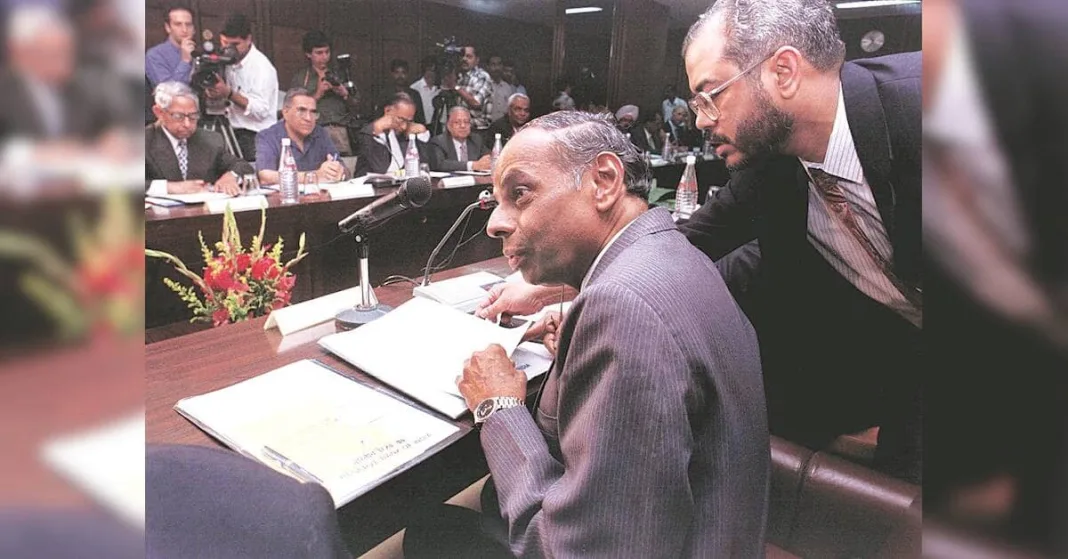
C Rangarajan, then deputy governor of the Reserve Bank of India, oversaw a two-step devaluation of the rupee on July 1 and 3, 1991 | Photo: Reuters
How did you view the economic reforms from Mint Street?
The reforms made a break with the past. They did away with the multitude of permits and licences that dominated the Indian economy. The role of the state was modified and finally the new strategy of development did away with the old import-substitution policy. By embracing international trade, India was accepting the challenge and opportunity of integrating into the world economy. This approach is very different from what we used to do when faced with BoP problems earlier. Narasimha Rao never used the word “break”; he always talked of “continuity” and the “middle path”. He did so because he had to carry not only the Opposition but also his own party. Manmohan Singh was right when he quoted and said liberalisation was an “idea whose time had come”.
You ended automatic monetisation of the Budget deficit in 1994. How did it start and why do you think it took so long to abolish it?
Automatic monetisation was the result of a seemingly innocuous agreement between the RBI and government under which when government balances fell below a particular level, it would be replenished by the issue of ad hoc treasury bills. I talked about it in a memorial lecture, and thereafter I had discussed the matter with Manmohan Singh. He immediately recognised the need to correct this. But we also recognised that the central government would also need some Ways and Means advances to tide over temporary mismatches between revenues and expenditures. This had to be worked out. This was part of our efforts to minimise monetisation of the Budget deficit.
Did the idea of banking reforms, including allowing private banks, come from Mahmohan Singh or the RBI?
One of the major elements in the reform process was to put an end to restrictions on entry and growth of firms. We wanted a more competitive environment in all areas. Extending this principle to the banking industry, we felt that more banks were needed and particularly in the private sector. There was no enactment barring the setting up of private banks. The provision in the Banking Act to allow for banks to set up in the private sector was not acted upon. So, I decided to allow new private banks to set up. This was discussed with the finance minister and the ministry. We had to also outline the criteria for setting up banks by the private sector. It must be understood that at that time there was a high degree of consultation and communication between the RBI and finance ministry. We worked together to usher in a new regime and that needed continued consultation among all.
Was there political opposition to stake sale in public sector banks (PSBs)?
Reducing the share of government holding in PSBs required talking with political parties. It is not just Opposition leaders alone. Even leaders of the Congress had to be convinced. The point that we made was that since the government would hold 51 per cent of the share capital, these banks would remain PSBs. It has also to be noted that reducing the stake took a long time. We had to convince private participants that investing in PSBs was worthwhile. This could happen only after we had strengthened the PSBs.
Was there any proposal or decision that you and Manmohan Singh deferred on?
As I mentioned earlier, we were going through a period in which we had to overcome the crisis and bring about fundamental changes in the development strategy. In this context, all the participants — the government and RBI — met often and thrashed out various concerns on major issues like putting an end to monetisation of fiscal deficit, moving towards a new exchange rate regime, bringing about changes in the banking system such as strengthening capital and introducing prudential measures. On these various measures there was no conflict. There could have been some differences on modalities, but we worked as a team as the criticality of times demanded it.
What is the unfinished agenda in banking reforms?
Reforms are a continuing phenomenon. As circumstances change, we need to introduce new measures to take care of new challenges. There are still issues to be addressed such as small banks versus large banks, universal banking, continuous authorisation, consolidation, role of foreign banks, operations of Indian banks overseas and government ownership. These need to be addressed on an ongoing basis.