
In the 1980s, Bombay’s skyline and economy were dominated by textile mills. Even as it began shedding its identity as a textile hub, its transition to a services-led economy — driven by banking and financial services, media and professional services — took time.
As the economy changed, so did Mumbai’s social fabric. Over the years, the famous Bombay Development Department chawls (or tenements that housed its culturally and regionally diverse industrial workforce), and the chawl system more broadly, began making way for multi-storeyed apartments. Dabbawalas, who carried meals for workers and were once an integral part of the landscape, dwindled in numbers as food-delivery platforms emerged. The ubiquitous kaali-peeli taxis began sharing the roads with Uber, Ola and Rapido.
A defining event in the city’s economic transition was the Great Bombay Textile Strike of 1982, led by union leader Datta Samant (File Photo: Reuters)
A defining event in Mumbai’s economic transition was the Great Bombay Textile Strike of 1982, led by the fierce union leader Datta Samant. The historian Gyan Prakash, in his book Mumbai Fables, dates the genesis of the strike to the slow decline of the mills in the face of the rapid shift brought in by power looms. The strike, which sought better wages, ended in a deadlock and was used by industrialists to shut down mills that employed thousands.
Two important regulatory changes arrived soon thereafter. The first was the introduction of Development Control Regulation no. 58 in 1991, which allowed mill owners to carve up their land into three parts. They could sell a third, transfer another third to the city corporation to provide open spaces, and the remaining part to provide affordable housing for mill workers who lost their livelihoods. This provided mill owners a route to use vacant mill land for development. The second major shift came with the ULC Act.
Niranjan Hiranandani, chairman of Hiranandani Group, says Mumbai real estate’s most consequential moment came in 1999, when the ULC Act was scrapped. “That single decision did more to reshape Mumbai’s built form than any policy of the liberalisation era. The Act had held the city in an artificial stranglehold for decades. When it was repealed, large contiguous parcels became developable, integrated townships became viable, and Mumbai could finally build at the scale its economy demanded,” he tells Business Standard.
Hiranandani adds that the 1991 reforms accelerated the transformation of the city because it allowed reallocation of land use driven not by government directive but by economic logic. “Liberalisation pushed Mumbai to redefine the value of mill lands, which had become uncompetitive and unviable. Hence, the mill land was naturally shifted from industrial use to redevelopment as prime real estate and a service asset to fetch better economic value,” says Hiranandani.
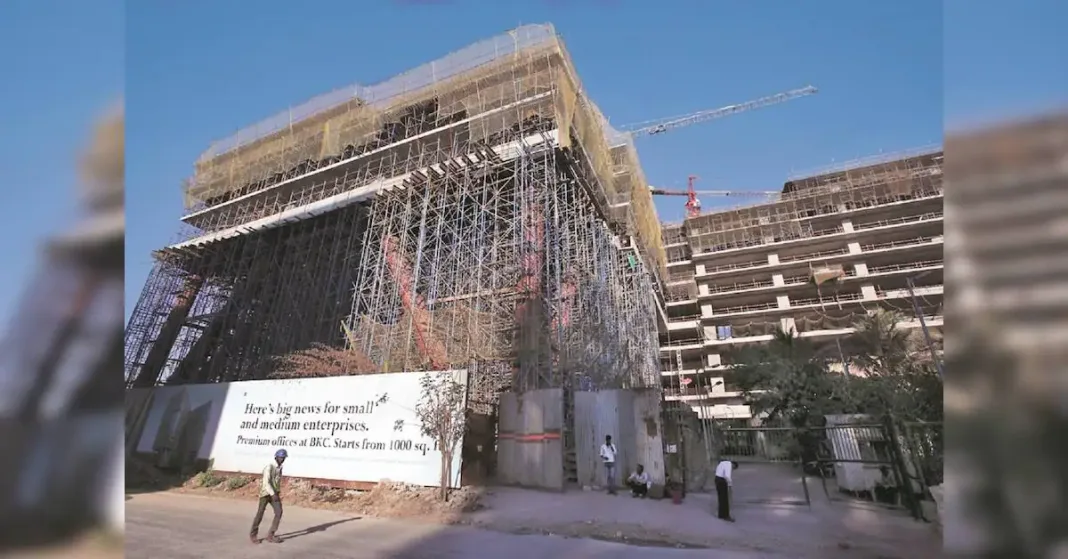
axis towards multiple commercial hubs such as Bandra-Kurla Complex (File Photo: Shutterstock)
Reforms and incentives for the information technology (IT) sector, including the setting up of special economic zones and software technology parks, also gave a new lease of life to areas such as Navi Mumbai. Though Navi Mumbai was envisaged by the state government’s city planning agency, City And Industrial Development Corporation (CIDCO), in the 1970s, it began seriously attracting businesses only in the 1990s and 2000s.
Since the reforms, Mumbai’s business gravity has shifted from the largely monocentric Fort-Nariman Point (File Photo: Sinha CC BY-SA 3.0 via Wikimedia Commons)
Cultural displacement
The changes in Mumbai were not restricted to real estate alone. As the city moved from being a manufacturing hub to a services-led economy, its culture and character changed as well.
Hardik Pandit, director of architecture and design consultancy APICES Studio, says one of the biggest shifts he noticed after the 1991 reforms was how quickly Mumbai became more global.
“Growing up, shopping meant going to local stores and a handful of brands. Over time, malls, international companies, and multinational offices became the norm. The old textile mill areas gradually gave way to commercial and residential developments, changing the city’s skyline,” he says. There was a palpable sense of economic optimism, but it also came with rising property prices, heavier traffic, and a widening gap between different sections of society, Pandit adds.
As chawls were demolished to make way for high-rise buildings, many original mill workers were pushed to the peripheries of the city. It also meant the decline of the closely networked way of life associated with the chawls. At their peak, the mills employed about 300,000 people.
Another quintessential part of Mumbai was the dabbawala. Their precision and working method have been chronicled by the Harvard Business School, while King Charles spent time with them during his visit to India in 2003. According to a BBC report, at their peak, 4,500 dabbawalas delivered around 50,000 lunches across the city.
But this famed profession, which many say began its journey in the 19th century, has been dwindling. Covid-19 dealt the first major blow to their services. Post-Covid, platforms such as Zomato and Swiggy, along with cloud kitchens, have offered users greater variety, often at discounted rates.
The transition was also reflected in Mumbai’s political landscape. Mill unions had traditionally been bastions of communist and socialist politics. But as the mills disappeared, the city’s political landscape changed too, paving the way for regional political parties such as the Shiv Sena to come to the forefront. The Shiv Sena government changed the city’s name from Bombay to Mumbai in 1995 to shed its colonial past.
Two industries, in particular, began changing the culture of the city — finance and IT/business process outsourcing (BPO).
Mumbai was at the forefront of the BPO boom. The industry helped create the nightlife and late-night economy that the city is now known for, largely because the sector catered to US markets.
It was the industry that truly started the 2 am cab economy — glass-facade offices, employees travelling at odd hours, and eateries staying open well into the night. Malad, Powai and Navi Mumbai became preferred locations.
“Navi Mumbai’s rise as a destination for IT, technology firms and back-office operations is the product of several converging factors rather than any single cause. At its foundation, it was a planned city, conceived by CIDCO precisely to absorb overflow from Mumbai, and that planning dividend has proven invaluable,” says Akshay Chaudasama, managing partner at the law firm Shardul Amarchand Mangaldas. It also offered significantly larger floor plates and contiguous land parcels at a fraction of Mumbai’s cost.
The other sector that reshaped Mumbai was finance. The launch of the Securities and Exchange Board of India (Sebi) and the National Stock Exchange (NSE), both located in their presence in Mumbai’s Bandra-Kurla Complex, fundamentally reshaped the country’s financial architecture after the 1991 reforms.
Triggered by a balance-of-payments crisis, the reforms marked a decisive shift towards liberalisation, deregulation and market-driven growth, including an overhaul of the financial sector aimed at deepening and modernising capital markets. This period saw Sebi become a statutory regulator in 1992 and the establishment of NSE, incorporated in 1992, as a technology-driven, nationwide electronic exchange — both central pillars of the new market ecosystem.
As these institutions expanded in the decades that followed, their eventual concentration in BKC became a physical manifestation of post-liberalisation India’s financial ambitions. Their presence anchored a cluster of banks, intermediaries and global firms, transforming BKC from a planned business district into a modern financial hub.
In effect, just as the 1991 reforms shifted India from a controlled to a market-oriented economy, the emergence of BKC symbolised — and accelerated — the shift in Mumbai’s financial gravity from the legacy Dalal Street-Nariman Point axis to a new financial centre.
One thread, however, continues to hold Mumbai together: Its infrastructure. Stories about Mumbai’s suburban railway, particularly the experience of navigating it as a non-Mumbaikar, are legendary. But the network continues to bind the city together.
Dikshu C Kukreja, urban planner, sustainability advocate and managing principal at CP Kukreja Architects, believes infrastructure has been equally decisive in changing the nature of the city. “The expansion of suburban rail connectivity, the Palm Beach Road corridor, the Mumbai Trans Harbour Link (MTHL), the recently opened Navi Mumbai International Airport (NMIA) and improving metro connectivity have progressively reduced the psychological and physical distance between different parts of the city,” he says.
Parag Munot, MD of real estate firm Kalpataru, says infrastructure has become one of the strongest catalysts of Mumbai’s urban transformation. “Today, where people choose to live and work is increasingly driven by connectivity. In many ways, Mumbai is shrinking — not geographically, but in terms of travel time,” he says. He highlights projects such as the metro, the Coastal Road, the Mumbai Trans Harbour Link and new expressways as bringing previously distant neighbourhoods closer together and unlocking new growth corridors across the Mumbai Metropolitan Region.
It is this build-out that could define the city’s next phase. The current government has already announced plans to develop Mumbai 3.0, a third city connecting the Karnala-Sai-Chirner region and Mumbai 4.0, a large new urban and industrial expansion project in the Palghar-Vadhavan region to serve as a logistics hub led by the ₹76,220-crore Vadhavan Port and the ₹45,000-crore Vadhavan Offshore Airport. Notably, the plans include simultaneously developing supporting infrastructure for better connectivity. A case in example is Mumbai 3.0, for which facilities like MTNL and NMIA are already operational.