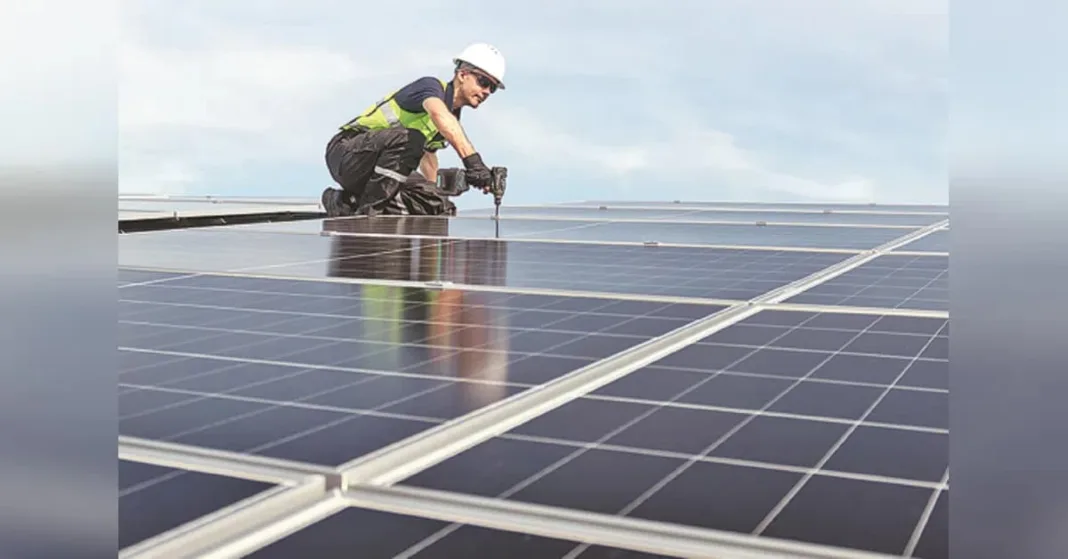

As the government lays out the policy architecture of the next phase of its flagship rooftop solar scheme, PM Surya Ghar Muft Bijli Yojana (PMSGMBY), industry leaders and experts are calling for the integration of battery energy storage systems (BESS) with rooftop solar (RTS), differentiated support and policy continuity to boost investor sentiment.
The Ministry of New and Renewable Energy (MNRE), as part of its consultations with think tanks, industry executives, vendors and discoms, has received proposals for BESS integration and expansion to rural areas, among others, it told Business Standard last week.
MNRE said while the consultations are at a preliminary stage and no decision has been taken, the intention is to identify implementation challenges and explore measures to support the long-term growth of the RTS ecosystem.
Battery storage can increase solar self-consumption, reduce grid dependence and lower electricity bills, according to Alekhya Datta, fellow and director, electricity and renewables division, The Energy and Resources Institute (TERI), who is part of the deliberations. He said that batteries can also reduce reverse power flow, moderate local voltage stress and help discoms manage peak demand.
According to TERI’s preliminary assessment, rooftop solar combined with appropriately sized batteries can generate value for both consumers and utilities. Datta highlighted that a hybrid BESS architecture would be preferable as it would include household batteries for consumer resilience, community- or feeder-level batteries for local network management and utility-scale systems for bulk balancing and renewable-energy integration. “The appropriate mix should be determined by feeder conditions, outage levels, solar penetration and local demand patterns,” he added.
If the BESS component is added as part of the scheme, the upfront investment could increase substantially, requiring capital support. “The support could be linked partly to actual discharge during evening and peak hours, when the value to the system is higher,” said Rohit Vijay, associate fellow, CSEP. However, he added that it can only be enforceable if eligibility is restricted to communicable inverters or battery management systems conforming to a notified protocol.
Experts also pointed out that financial assistance must be directed towards segments and interventions where market adoption would otherwise remain weak. “Support should be differentiated. Lower-income households need higher direct assistance and easier access to the roughly 7 per cent collateral-free loans that already exist, with eligibility drawn from databases the government already has, such as Pradhan Mantri Awaas Yojana or sanctioned load,” said Vijay.
Under the current scheme, the government has implemented utility-led aggregation (ULA) models for low-income households through which demand is aggregated and implementation is supported by distribution utilities. Under the model, MNRE has sanctioned about 13 lakh RTS installations across 10 states or Union Territories.
While this model, along with arrangements for tenants and housing societies, can help reach households without an owned roof or the ability to make the upfront investment, it needs to become easier to implement at the discom level, according to industry representatives.
They also call for avoiding sudden policy changes as those can be counterproductive. Shreya Mishra, co-founder of SolarSquare, a rooftop solar company, said that during the consultations with the ministry, there were representations about ensuring that there is no discontinuity in the market to restore consumer sentiment.
“About 10–15 lakh people are employed by the residential solar market and there are more than 30,000 vendors working in residential solar, specifically in the PM Surya Ghar scheme. It is very important that policy is well thought through, announced in advance, so that companies can plan their investments and sales in advance,” she said.
Mishra also added that her company made the representation that subsidy for residential solar should be tapered down and not brought down to zero at once because it can severely impact consumer sentiment, the market can have a dry spell and it will risk the employment that the industry supports.
Additionally, there have been concerns over the quality of installations and maintenance support, which need to be addressed through the scheme. “The scheme should build an organised after-sales market, an accredited O&M provider category on the portal, standard maintenance contracts’ templates, Suryamitra-certified technicians, and mandatory handover of warranty documents and as-built records at commissioning,” said Vijay.
Moreover, at the discom level, the incentive should not be based only on how much rooftop capacity is added, he said, adding that it should also reward good integration, reliable settlement and the ability to use distributed resources during peak periods. “That would give them a reason to see rooftop solar as part of distribution planning rather than simply as a reduction in electricity sales,” he said.
In order to maintain the momentum of demand beyond the 1 crore installations as part of the current scheme, several measures will be required, such as concessional financing, utility-led aggregation models with little or no upfront consumer investment, discom benefit-sharing through electricity-bill credits, time-of-day tariffs and incentives for peak-period battery discharge, targeted assistance for low-income households and constrained feeders and a guaranteed backup portion of battery capacity as an additional non-cash benefit to consumers, TERI’s Datta said.
“The objective should be to move gradually from a pure capital subsidy towards a combination of affordable finance, performance-linked incentives and payments for measurable grid services,” he added.
The scheme, with an outlay of ₹75,021 crore, targets covering 1 crore households by FY27. As of now, total installations stand at 50 lakh, with an installed capacity of 14.8 gigawatts. Subsidies of ₹28,024 crore have been released to beneficiaries.