
Published on
March 21, 2026

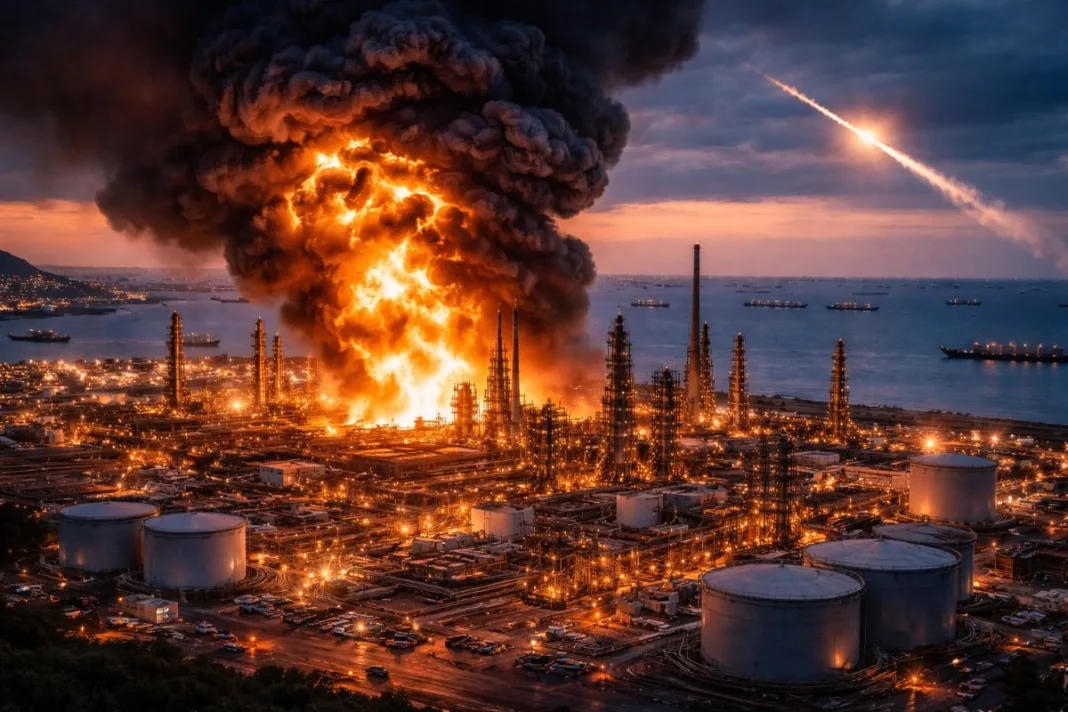
Image generated with Ai
On March 19, 2026, an alarming event unfolded as a sophisticated drone breached the SAMREF refinery’s security perimeter in Yanbu, located on Saudi Arabia’s western coast along the Red Sea. The refinery, a crucial joint venture between Saudi Aramco and ExxonMobil, processes hundreds of thousands of barrels of crude oil each day, playing a pivotal role in fueling the global energy market.
The attack set off a fire, which emergency teams quickly contained. However, this physical damage was the least of the concerns; the geopolitical consequences of the strike were far-reaching. Yanbu, sitting at the end of the East-West pipeline that bypasses the congested and contested Strait of Hormuz, is a strategic point for energy exports. This attack highlights the critical vulnerability of global oil transit routes and the immense risks posed by geopolitical tensions in the Middle East.
Ballistic Interception: Saudi Air Defense Prevents Further Catastrophe
As if the drone strike weren’t enough, a secondary missile threat aimed at the Yanbu port was intercepted by Saudi Arabia’s air defense systems, notably the Patriot missile batteries. This swift action by the Saudi Arabian Strategic Missile Force prevented a more significant disruption to maritime traffic, underscoring the increasing militarization of energy routes and the heightened state of alert in the region.
With these coordinated strikes, attackers seem to have sent a clear message: no place along the Red Sea, once considered relatively secure, is off-limits. This development places not just Saudi Arabia’s critical infrastructure at risk but also the global flow of oil, affecting both the transport of energy across Asia, Europe, and beyond.
Yanbu: A Strategic Junction in the Global Energy Network
Why would an area like Yanbu, which has long been regarded as a “safe zone” for energy exports, become the focus of an attack? The answer lies in the growing importance of the Red Sea as an alternative to the heavily congested Strait of Hormuz. Saudi Arabia has invested heavily in the East-West Pipeline to bypass the vulnerable Strait of Hormuz, and Yanbu is at the terminus of this critical artery.
SAMREF, located in Yanbu, is one of the world’s key refineries, with the capacity to process around 400,000 barrels of crude per day. It provides refined fuels such as gasoline and diesel that are vital for transportation sectors in Europe and North America. A disruption here would not just be a local issue for Saudi Arabia; it would send ripples through the global economy, particularly the travel and transport sectors, which rely on the stability of energy prices.
Advertisement
Advertisement
A Growing Energy War in the Middle East
Though no group has officially claimed responsibility for the attack, Saudi officials have suggested that this assault fits into a broader pattern of coordinated regional aggression. The sophistication of the drone, designed for low-altitude, radar-evading flight, suggests that this may not be the work of a random militant group but a well-coordinated state actor with substantial resources and expertise.
The timing of the attack is also telling, coming just after heightened tensions surrounding incidents at Iran’s South Pars gas field. As energy resources become increasingly contested, especially in such strategically vital regions, the world is witnessing a growing “energy war” playing out through proxy battles, high-tech strikes, and diplomatic maneuvering.
Advertisement
Advertisement
The Impact on Global Oil Prices and the Economy
Despite assurances from SAMREF officials that production was only minimally affected, the global oil market reacted with immediate concern. Brent Crude prices saw a significant intraday spike, a reflection of the market’s sensitivity to security risks in key energy transit routes. This price surge highlights just how vulnerable the global energy system is to disruptions—even those that, on the surface, may seem localized.
For the West, where oil is critical to everything from travel to heating homes, the implications are severe. Any major disruption to supply—whether from natural disasters, political instability, or even targeted attacks—could quickly translate into price hikes, economic slowdowns, and instability in vital sectors like transportation.
Fortifying Yanbu: Saudi Arabia’s Response to the Attack
In the aftermath of the attack, Saudi Arabia moved quickly to bolster its security. The Kingdom has announced an overhaul of its Integrated Defense Umbrella, deploying additional electronic warfare units and directed-energy weapons to secure the Yanbu and Rabigh industrial corridors. These measures are designed to ensure that the flow of oil through this crucial channel remains uninterrupted and to protect the broader region’s energy infrastructure from future threats.
In addition, the Ministry of Interior has ramped up security measures around other high-risk sites, including desalination plants and petrochemical hubs. The clear message from the Saudi government is that every inch of its energy infrastructure must be fortified against the rising threat of asymmetrical warfare.
Global Calls for Maritime Security
The international community has condemned the attack, with governments calling for greater security on global energy routes. The Red Sea, a vital shipping lane for oil and goods between Asia and Europe, has been emphasized as a “global commons” that requires international cooperation to safeguard. The incident has drawn attention to the fact that the travel of oil and goods via these critical maritime lanes is a collective global responsibility.
As Saudi Arabia continues to assess the damage to SAMREF and strengthen its defense measures, the Yanbu attack serves as a stark reminder that in the modern geopolitical landscape, energy infrastructure is increasingly vulnerable to asymmetric threats. The world’s dependence on secure, stable energy transit routes makes every pipeline, refinery, and port a potential target.
The Future of Global Energy and Travel Routes
In conclusion, the drone strike on Yanbu is not just an isolated incident. It is a signal of a new era in which the global energy and travel routes are increasingly at risk from sophisticated attacks. The tension in the Red Sea, combined with rising geopolitical instability in the broader Middle East, has created a volatile situation for global oil flows.
As the international community grapples with how to respond, the world’s energy infrastructure will need to adapt to new realities. The future of energy travel will be shaped not just by market forces but by a new set of security and geopolitical challenges that threaten the very arteries through which the lifeblood of global commerce flows.