

US air travel system is under fresh review after the Trump administration requested $50.1 billion for aviation infrastructure upgrades to get the nation’s air travel system back on track following a system-wide disruption. Transportation Secretary Sean Duffy asked Congress for years of upgrades after a Federal Aviation Administration (FAA) telecommunications failure left air-traffic operations temporarily grounded. But Republican and Democratic legislators expressed concern over the size of the funding request, which was announced as the agency probes failing network hardware, evaluates potential vulnerabilities in aging systems and preps for a busy holiday travel period.
Why Is the Trump Administration Seeking $50 Billion to Modernise US Air Travel
The Trump administration wants Congress to approve a substantial investment in America’s aviation infrastructure after technical failures exposed weaknesses in the national air traffic control network. The proposal divides approximately $50.1 billion into five major funding categories, including around $10 billion for air traffic control modernisation.
Advertisement
Advertisement
Duffy has argued that years of fragmented investment have left the Federal Aviation Administration dependent on ageing communications equipment. His department wants a broader programme that addresses technological reliability, infrastructure limitations and operational safety.
However, the proposal faces resistance in Congress. Several Republican senators support improvements to critical aviation systems but question whether taxpayers should finance every project within the administration’s wider infrastructure package.
Senator Ted Cruz, who chairs the Senate Commerce, Science and Transportation Committee, has raised concerns about funding projects that do not directly improve aviation safety. Other lawmakers have questioned whether airport infrastructure improvements and terminal replacements deserve the same priority as essential communications upgrades.
Senator John Kennedy has supported replacing outdated copper telecommunications cables with modern fibre-optic technology while opposing the full funding request. Senator Rick Scott has suggested that airlines should contribute more towards certain improvements.
Advertisement
Advertisement
Democratic lawmakers have also demanded greater transparency over the administration’s modernisation plans and the technical failures that disrupted air travel.
The political disagreement could delay a comprehensive funding agreement. Nevertheless, Duffy has indicated that the administration could accept phased investment, beginning with the infrastructure most critical to aviation safety.
How Did the FAA Network Failure Disrupt Thousands of Flights Across America
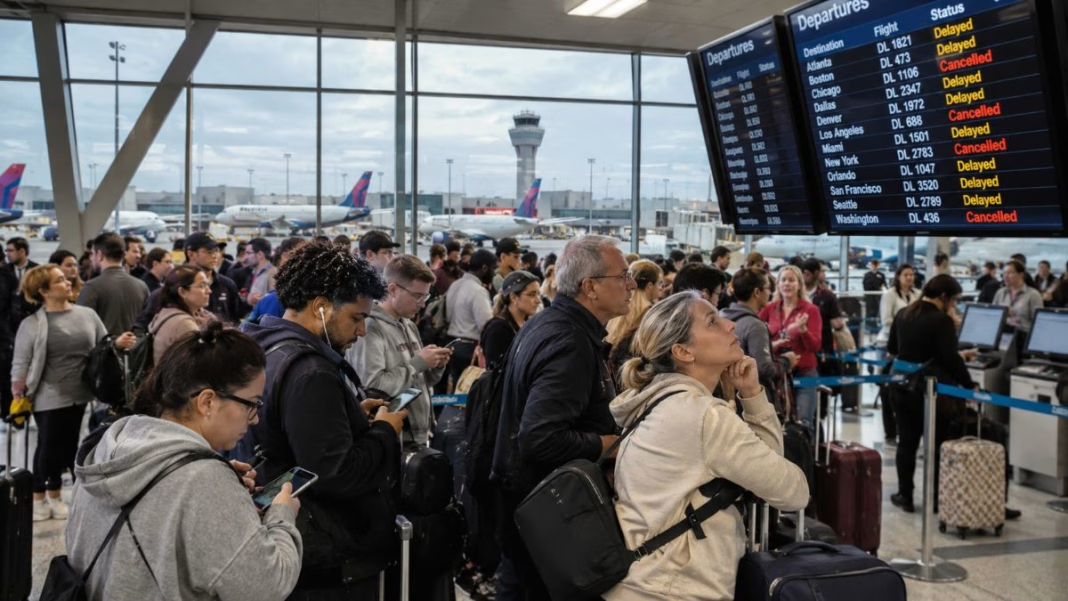
The latest aviation crisis began on 13 November 2026, when the FAA detected instability in its telecommunications and radar systems. Officials ordered a nationwide ground stop at approximately 3.30 pm Eastern Time to protect aircraft operations.
The FAA restored air traffic at approximately 8.15 pm. Its subsequent report recorded around 12,462 flight cancellations that day, including 9,082 cancellations by major airlines, although not every cancellation resulted directly from the ground stop.
Investigators traced unusual network activity to equipment associated with facilities in El Dorado, Arkansas, and Amarillo, Texas. The disruption occurred during a nationwide programme to replace ageing copper communications lines with fibre-optic infrastructure.
The FAA identified excessive network traffic as a major technical concern. Its systems encountered approximately 1,000 connection attempts every four to five seconds, creating instability in aircraft communications and radar information.
Advertisement
Advertisement
Officials subsequently suspended new installations of Juniper routers and disabled specific functions on more than 60 existing devices. The agency continues to investigate the underlying technical cause.
Where Will the Proposed $50.1 Billion Aviation Investment Go
The administration’s proposal covers five infrastructure priorities. The US Department of Transportation published the following funding breakdown on 17 November.
| Infrastructure priority | Proposed investment |
|---|---|
| Air traffic control technology and digital systems | $10.1 billion |
| Airport infrastructure improvements | $10 billion |
| Modernisation of ageing airport terminals | $10 billion |
| Five consolidated regional air traffic control centres | $10 billion |
| Construction and upgrades of up to 140 control towers | $10 billion |
| Total | $50.1 billion |
The administration also wants to replace outdated regional control facilities and improve the resilience of aviation communications. Congress must approve the additional funding before the government can implement the complete programme.
Which American Airports Still Need Major Infrastructure Improvements
Several airports have documented construction programmes, expansion plans or outstanding modernisation requirements. Their inclusion below does not mean the FAA has formally designated them as recipients of the proposed new funding.
| Airport and city | Outstanding infrastructure requirement | Why further investment matters | Verified position in 2026 |
|---|---|---|---|
| New York JFK, New York | New terminals, roads, ground transport infrastructure and supporting utilities | Modernise international passenger processing and improve airport access | Major $19 billion redevelopment programme underway |
| Newark Liberty (EWR), New Jersey | Terminal A expansion, additional gates and passenger facilities | Provide more aircraft gates and passenger capacity | $110 million authorised in September 2026; expansion planned for 2029–2030 |
| San Diego (SAN), California | Additional Terminal 1 gates, lounges and passenger amenities | Complete the terminal replacement programme and accommodate future demand | Phase 1B underway; 11 more gates planned for 2028 |
| Atlanta (ATL), Georgia | Runway and taxiway reconstruction, terminal works and safety areas | Preserve reliable airfield operations | Multiple FAA grants announced in 2026 |
| Los Angeles (LAX), California | Improved terminal access roads | Reduce ground-access bottlenecks | $289 million |
| Miami (MIA), Florida | Terminal roof reconstruction | Address ageing infrastructure and protect passenger facilities | $50 million |
| Louisville (SDF), Kentucky | Terminal reconstruction | Renew passenger infrastructure | $32.5 million |
| San Antonio (SAT), Texas | Airfield drainage and erosion control | Protect airport infrastructure from water damage and deterioration | $40.9 million |
New York JFK and Newark provide particularly clear examples of airports with significant ongoing capital requirements. Their programmes involve major construction extending beyond 2026. However, these projects already have identified development and financing arrangements, so they should not automatically be described as dependent on the administration’s latest congressional request.
What Should Travellers Do to Avoid Further US Flight Disruptions
Passengers travelling across the United States should monitor airline communications closely, particularly during the busy Thanksgiving period.
Advertisement
Advertisement
- Check flight status: Review airline apps and the official FAA National Airspace System Status service before travelling.
- Allow extra time: Reach airports early when airlines report operational disruption.
- Review connections: Avoid unnecessarily tight connections, especially on multi-leg itineraries.
- Understand refund rights: Check the US Department of Transportation refund guidance when airlines cancel or significantly change flights.
- Keep essential items accessible: Carry medication, travel documents and necessary personal belongings in cabin baggage.
Travellers should also contact their airline directly for rebooking arrangements. A nationwide ground stop does not automatically mean every scheduled flight will face cancellation.
What Happens Next for American Aviation
The FAA has resumed normal operations after the nationwide outage, but they continue to probe what went wrong. The authorities need to find out how the new network hardware caused the instability before restart the compromised.
At the same time, Congress has a tough choice to make about the administration’s investment. They could greenlight a handful of safety projects ahead of fully funding the entire programme.
For travellers the key issue remains operational reliability. The funding battle will decide how fast the United States can swap out its aging aviation system and bolster its defenses against future network breakdowns.