

London Heathrow and Gatwick airports faced travel chaos as a major US air traffic shutdown disrupted international flights, leaving passengers dealing with cancellations, delays and uncertain travel arrangements. The crisis began on 13 November 2026, when the Federal Aviation Administration (FAA) grounded departures across the United States following telecommunications problems affecting air traffic control systems. The disruption reached the United Kingdom, affecting transatlantic connections and scheduled arrivals. Although American authorities reopened US airspace after several hours, airlines faced further operational challenges. The incident highlighted how aviation infrastructure failures can affect international tourism, business travel and passengers travelling between Britain and North America.
What Caused the US Air Traffic Shutdown and Widespread Flight Disruption?
The nationwide aviation emergency began when communication problems affected several American air traffic control facilities.
According to the FAA, intermittent telecommunications failures created instability in radar information and communications between controllers and aircraft.
As a precaution, aviation authorities introduced a nationwide ground stop, preventing departing aircraft from taking off at US airports.
Advertisement
Advertisement
The initial restriction began at approximately 20:53 UTC on 13 November. International flights already approaching American airports were handled individually.
The US Department of Transportation reported that more than 3,500 aircraft were airborne when the situation developed.
Advertisement
Advertisement
As controllers managed the disruption, the number remaining airborne fell below 400.
Officials subsequently reopened US airspace, but warned that normal operations would take time to restore.
Advertisement
Advertisement
The emergency demonstrated the importance of reliable air traffic infrastructure in maintaining safe and efficient international aviation.
Which London Heathrow Flights Were Affected by the US Aviation Crisis?
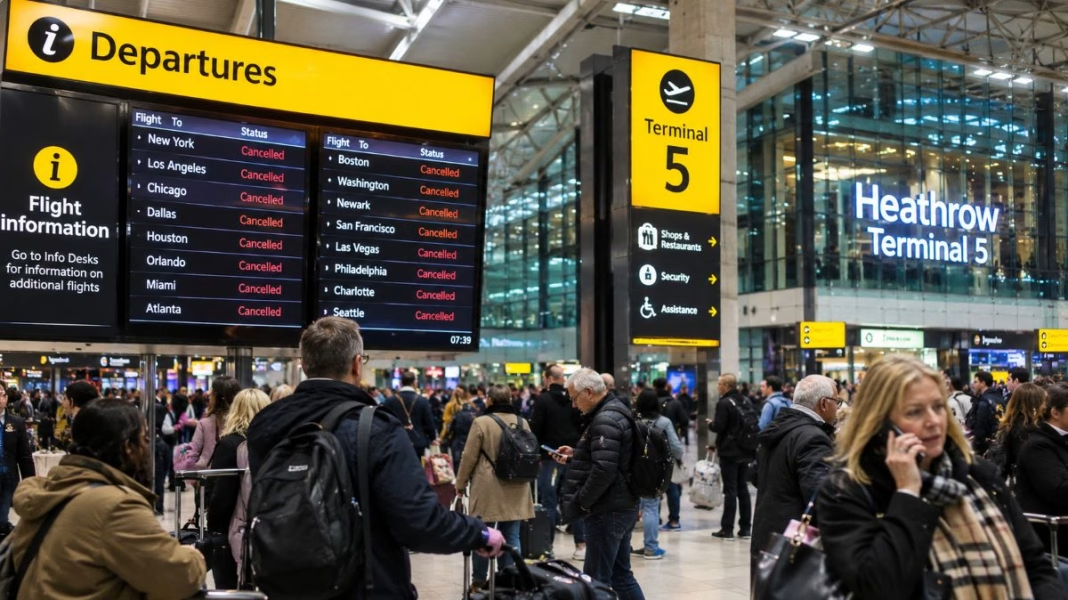
London Heathrow experienced cancellations and delays involving transatlantic services after the American air traffic restrictions disrupted airline operations.
The affected travel corridors included major US destinations such as New York, Dallas, Chicago, Houston and Los Angeles.
Heathrow serves as an important gateway for passengers travelling between Britain and the United States, including holidaymakers, business travellers and passengers making onward connections.
Advertisement
Advertisement
The disruption created uncertainty for travellers whose journeys depended on aircraft arriving from American airports.
Previous reports identified 29 cancelled Heathrow flight listings, comprising 13 departures and 16 arrivals. However, this figure could not be independently confirmed through a complete official historical airport record.
Consequently, it should not be treated as a verified final cancellation total.
Passengers were advised to check their flight status directly with airlines because airport schedules could change during the recovery period.
How Did London Gatwick Experience Flight Cancellations?
London Gatwick recorded cancelled airline listings for a scheduled arrival from Orlando, Florida, on 14 November.
The airport’s official flight information identified three cancelled flight numbers associated with the same 07:30 arrival.
Advertisement
Advertisement
These listings involved British Airways, American Airlines and Iberia.
Confirmed Gatwick Cancellation Listings
| Airline | Flight number | Origin | Scheduled arrival |
|---|---|---|---|
| British Airways | BA2036 | Orlando | 07:30 |
| American Airlines | AA6205 | Orlando | 07:30 |
| Iberia | IB4678 | Orlando | 07:30 |
Importantly, the three flight numbers represented codeshare listings associated with one scheduled service, rather than three separate aircraft cancellations.
The cancellation was particularly relevant to passengers returning from Florida, a popular destination for British family holidays.
Gatwick’s wider operations continued, although travellers using transatlantic services were advised to monitor airline information.
The airport record confirmed the cancellation status but did not independently establish the precise operational cause of the individual Orlando service.
Why Did Flight Disruption Continue After US Airspace Reopened?
Although the nationwide ground stop ended, airlines faced additional challenges when attempting to restore normal operations.
Advertisement
Advertisement
Aircraft that had been delayed or grounded were no longer positioned according to their original schedules.
Some crews also faced working-hour restrictions, requiring airlines to arrange replacement pilots and cabin staff.
Furthermore, passengers who missed connecting flights needed alternative travel arrangements.
These problems can continue after an air traffic restriction ends because commercial aviation depends on closely coordinated aircraft and crew movements.
Long-haul routes are especially vulnerable to such disruption.
An aircraft delayed in the United States may arrive late in Britain, affecting its next scheduled departure.
Advertisement
Advertisement
The US Department of Transportation acknowledged that airlines would need time to reposition aircraft and restore services.
For international tourists, this meant that reopening American airspace did not necessarily guarantee an immediate return to normal travel.
What Do Official Statistics Reveal About the Aviation Shutdown?
The FAA’s operational notices and the US Department of Transportation’s statements provide important information about the incident.
US Air Traffic Shutdown: Official Facts
| Indicator | Confirmed information |
|---|---|
| Incident date | 13 November 2026 |
| Main cause | Telecommunications and air traffic control data instability |
| Initial ground-stop advisory | 20:54 UTC |
| Nationwide restriction | All US airports |
| Aircraft initially airborne | More than 3,500 |
| Aircraft remaining airborne at a later update | Fewer than 400 |
| Ground-stop duration | Approximately four hours |
| International arrivals | Managed individually |
| Main recovery challenge | Aircraft and crew repositioning |
The initial FAA advisory recorded the ground stop shortly before 21:00 UTC.
Authorities subsequently introduced phased recovery procedures as communications improved.
The figures illustrate the scale of the operational response, although they do not establish how many passengers were directly affected.
Advertisement
Advertisement
No complete official Heathrow and Gatwick passenger disruption total was available in the verified information reviewed.
How Could the Shutdown Affect Transatlantic Tourism and Business Travel?
The disruption highlighted the vulnerability of international travel when essential aviation infrastructure experiences unexpected failures.
London’s airports provide connections to major American cities and onward destinations across North America.
Passengers use these routes for leisure holidays, corporate meetings, educational travel and family visits.
Unexpected cancellations can affect hotel reservations, connecting flights, airport transfers and pre-booked tourism experiences.
For business travellers, delayed arrivals may also disrupt scheduled meetings and professional events.
Advertisement
Advertisement
The effects can extend beyond the original airport because airlines operate interconnected international networks.
However, no verified official figures have established the financial losses experienced by British tourism businesses following the incident.
The disruption nevertheless demonstrated how quickly an operational emergency in the United States can create consequences for international travellers and tourism service providers.
What Compensation and Assistance Can Affected Passengers Receive?
Passengers whose flights were cancelled may qualify for assistance under applicable UK aviation regulations.
The UK Civil Aviation Authority states that eligible travellers must be offered a refund or suitable alternative transport.
Airlines may also need to provide reasonable meals, refreshments and overnight accommodation when passengers experience qualifying disruption.
Advertisement
Advertisement
However, fixed financial compensation depends on the cause of the cancellation.
Air traffic control failures may qualify as extraordinary circumstances outside an airline’s control.
UK Passenger Rights Following Flight Cancellations
| Passenger issue | Possible entitlement |
|---|---|
| Cancelled flight | Refund or alternative transport |
| Extended waiting period | Reasonable meals and refreshments |
| Overnight disruption | Accommodation where required |
| Hotel transfers | Reasonable transport arrangements |
| Long-haul cancellation compensation | Up to £520 when legally applicable |
| Extraordinary circumstances | Fixed compensation may not apply |
| Additional reasonable expenses | Possible reimbursement with supporting receipts |
Travellers should retain receipts for necessary expenses and contact their operating airline regarding reimbursement.
Passengers should also remember that airline assistance obligations may continue even when fixed compensation is unavailable.
Conclusion: Why Did the US Shutdown Create Problems for London Travellers?
The nationwide US air traffic shutdown disrupted travel involving Heathrow and Gatwick because international aviation relies on reliable communications, available aircraft and coordinated airline schedules. The telecommunications failure forced American authorities to suspend departures, creating operational challenges that extended beyond US airports. Although the restriction ended after several hours, airlines needed additional time to restore services and accommodate affected passengers. The incident demonstrated how aviation emergencies can interrupt tourism and business travel between major international destinations. For travellers, the experience reinforced the importance of monitoring flight updates, understanding cancellation rights and preparing for unexpected changes when travelling internationally.