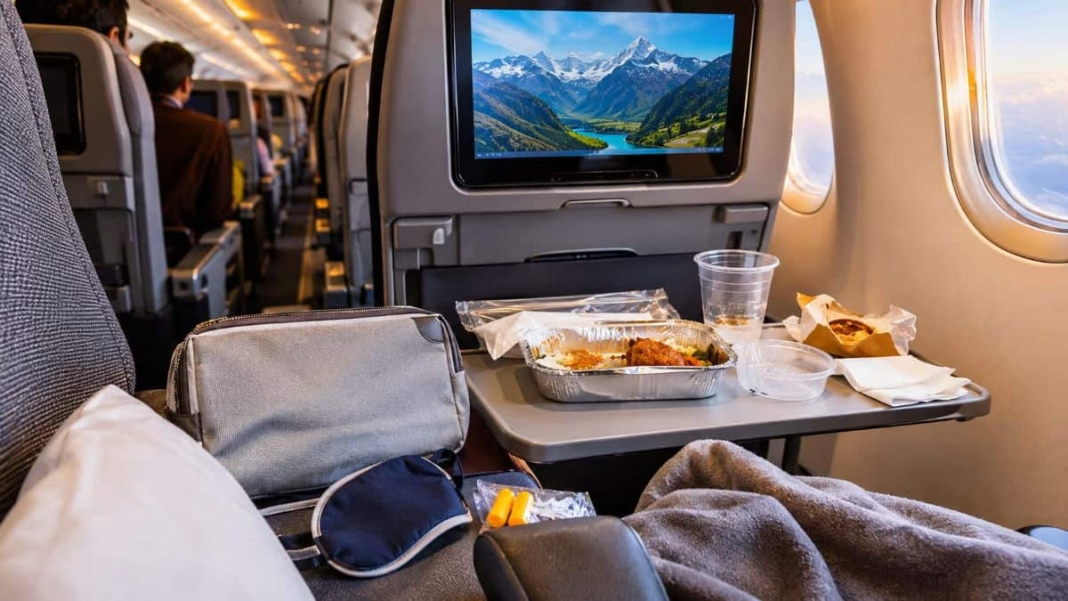


Airlines are facing growing pressure to reconsider complimentary passenger services as unused amenity kits, uneaten meals and disposable cabin products increase operational waste. New industry data from the International Air Transport Association (IATA) reveals that aviation generated an estimated 3.6 million tonnes of cabin waste in 2023. Meanwhile, major carriers continue investing in premium amenities and entertainment technology to attract passengers. Singapore Airlines unveiled an expanded onboard experience on 6 November 2026, while American Airlines is restoring seatback entertainment across its narrowbody fleet. These contrasting developments raise an important question: can airlines improve passenger comfort without increasing unnecessary consumption, operating costs and environmental pressure?
Aviation’s Complimentary Services Face a Reality Check
The traditional airline experience has long relied on complimentary products to distinguish full-service carriers from their lower-cost competitors. Meals, refreshments, amenity kits, blankets and entertainment systems have become familiar features of international flying. However, passenger expectations and environmental priorities are changing.
Airlines increasingly operate in a market where travellers expect convenience, personalisation and transparent pricing. Yet, distributing identical products across every seat does not necessarily satisfy individual preferences. Some passengers appreciate complimentary toiletries and packaged refreshments, while others prefer travelling with personal essentials.
This difference creates a challenge for airline procurement teams. Every product distributed onboard requires purchasing, packaging, transportation, storage and eventual disposal. Moreover, unused products can create additional work for cleaning contractors and catering providers.
The problem becomes particularly significant on long-haul services. These flights generally require more catering, refreshments and personal comfort provisions than shorter journeys. Consequently, they can generate substantially greater quantities of cabin waste.
For airline executives, the issue extends beyond environmental responsibility. It concerns whether existing service models deliver sufficient commercial value to justify their associated expenses. The next phase of airline competition may depend on providing more relevant services rather than simply distributing more products.
Advertisement
Advertisement
IATA Data Reveals the Scale of Cabin Waste
The environmental implications are becoming increasingly difficult to overlook. IATA’s cabin-waste research provides an important industry benchmark for understanding the problem. Its 2023–2024 audit programme examined 25 inbound flights arriving at Singapore Changi Airport.
The research identified average cabin waste of 0.94 kilograms per passenger. This represented approximately 237.3 kilograms of discarded material per flight. Extrapolating the findings, IATA estimated that the aviation industry generated around 3.6 million tonnes of cabin waste during 2023.
The association also identified significant differences between flight categories. Long-haul services generated more waste per passenger than shorter journeys. Their greater catering requirements and extended onboard service periods help explain this difference.
| Flight category | Average waste per flight | Average waste per passenger |
|---|---|---|
| Short-haul | 148 kg | Not separately specified in the published chart |
| Medium-haul | 209 kg | Not separately specified in the published chart |
| Long-haul | 301.1 kg | 1.22 kg |
| All audited flights | 237.3 kg | 0.94 kg |
The long-haul findings also indicate progress compared with earlier research. A Heathrow audit conducted in 2012–2013 recorded approximately 1.43 kilograms of cabin waste per passenger. The newer long-haul audit recorded 1.22 kilograms, representing a reduction of approximately 15%.
Nevertheless, IATA warns that the industry needs more consistent waste monitoring. Different contractors frequently handle catering waste and cabin-cleaning waste. This separation makes it difficult to establish a complete picture of discarded materials and their associated costs.
The organisation also estimates that cabin waste could double by 2040 if passenger growth continues along current trajectories. Therefore, improvements in onboard consumption and waste management will become increasingly important.
Advertisement
Advertisement
Unused Amenity Kits Challenge Premium Branding
Amenity kits remain among the most recognisable features of premium airline services. Airlines distribute these packages to reinforce brand identity and improve passenger comfort, particularly on international overnight flights.
Typical kits contain eyeshades, socks, toothbrushes, toothpaste, skincare products and other personal-care essentials. However, passengers do not necessarily require every item. Some already carry their own toiletries, while others prefer familiar products suited to their personal requirements.
This creates a mismatch between standardised distribution and actual consumption. An airline may purchase thousands of kits for a particular flight schedule without knowing how many passengers will use their contents.
Packaging presents another challenge. Individual products frequently arrive in plastic wrappers, disposable containers or specially designed bags. Although some passengers retain the outer packaging, others discard it immediately after arrival.
Premium carriers face a particularly delicate balancing act. Reducing amenities could undermine their luxury positioning, while distributing unnecessary products creates avoidable expenditure and waste.
The opportunity lies in developing more useful products and offering passengers greater control. Airlines could introduce advance amenity selection, provide essential items on request and prioritise reusable packaging. However, such changes must preserve reasonable comfort and accessibility standards.
Advertisement
Advertisement
Singapore Airlines Invests in a New Cabin Experience
Singapore Airlines demonstrates how premium carriers continue to regard complimentary amenities as an important competitive advantage. On 6 November 2026, the airline unveiled a broader end-to-end travel experience featuring upgraded cabin products, entertainment, dining and personal amenities.
The investment extends across several areas of the passenger journey. Its next-generation KrisWorld entertainment system will feature 4K touchscreens, selected OLED displays, spatial audio and Bluetooth headphone connectivity. The platform will also provide more than 2,500 entertainment options.
The airline is introducing a redesigned amenity collection across its cabin classes. Suites and First Class passengers will receive products from SISLEY, while Business Class customers will receive BYREDO amenities. Premium Economy kits will feature products from INK & WATER.
Economy Class passengers will receive specially designed collectible pouches containing travel essentials. Singapore Airlines is also introducing 100% cotton sleeper suits for Suites and First Class passengers. Business Class customers will receive sleeper suits for the first time.
The wider programme includes more than 100 new and refreshed dining options. These cover appetisers, main courses and desserts across the airline’s cabin classes. Enhanced beverage choices and redesigned serviceware also form part of the investment.
| Cabin class | Announced amenities and improvements | Passenger benefit |
|---|---|---|
| Suites and First Class | SISLEY amenities, cotton sleeper suits and upgraded serviceware | Enhanced comfort and luxury |
| Business Class | BYREDO amenities and newly introduced sleeper suits | Improved overnight experience |
| Premium Economy | INK & WATER products and redesigned amenities | Additional personal comfort |
| Economy Class | Collectible travel-essential pouch | Convenient basic travel products |
This investment illustrates why airlines cannot simply abandon complimentary services. Premium products remain central to differentiation, particularly on competitive international routes. However, the commercial value of these investments ultimately depends on passenger satisfaction and actual usage.
Advertisement
Advertisement
American Airlines Reconsiders Seatback Entertainment
Entertainment technology provides another example of changing airline priorities. For several years, airlines increasingly encouraged passengers to use smartphones and tablets instead of dedicated seatback screens.
American Airlines is now taking a different approach. In August 2026, the carrier announced plans to introduce seatback entertainment screens at every seat across its narrowbody fleet. New Airbus and Boeing aircraft deliveries will begin receiving the systems from 2028.
The airline also plans to retrofit existing aircraft, with installation expected to finish by the early 2030s. Its new entertainment platform will offer 4K displays, Bluetooth connectivity and USB-C charging facilities.
This decision reflects the continuing importance of onboard entertainment. Personal devices offer flexibility, but they also depend on battery capacity, storage space and passengers’ existing subscriptions. Dedicated screens provide an alternative without requiring travellers to prepare their own entertainment libraries.
American is simultaneously expanding premium seating across its narrowbody aircraft. Premium seats currently represent approximately 25% of narrowbody departure seats. The airline aims to increase that proportion to around 40%.
These developments demonstrate that airline investment decisions involve more than reducing equipment weight. Passenger comfort, brand positioning and competitive differentiation also influence fleet-modernisation strategies.
Advertisement
Advertisement
Nevertheless, equipment manufacturers are working towards lighter entertainment systems. Panasonic Avionics has previously claimed that its latest technology can weigh up to 30% less than earlier systems. Such improvements could help airlines balance passenger services with aircraft efficiency.
The Economics Behind Every Complimentary Product
Complimentary onboard services generate costs across several operational departments. Airlines must purchase products, negotiate supplier contracts, transport inventory and coordinate deliveries with catering facilities.
Food services involve particularly complicated forecasting. Carriers must estimate passenger demand across different routes, departure times and cabin classes. They must also accommodate dietary requirements and special meal requests.
When passengers decline meals, airlines cannot always redistribute the products. Food safety requirements, flight schedules and storage limitations restrict their options. Consequently, unused meals can become unavoidable waste.
Aircraft weight also influences operating efficiency. Catering supplies, entertainment equipment, packaging and onboard inventory all contribute to the aircraft’s total operating load. Additional weight can increase fuel consumption, although the precise effect varies by aircraft, route and operating conditions.
The financial impact is therefore distributed across several activities.
Advertisement
Advertisement
| Operational area | Associated cost | Potential improvement |
|---|---|---|
| Procurement | Purchasing unused products | Demand-based purchasing |
| Catering | Preparing uneaten meals | Improved forecasting |
| Packaging | Disposable wrappers and containers | Reusable alternatives |
| Logistics | Transporting additional inventory | Better stock management |
| Aircraft operations | Carrying unnecessary equipment and supplies | Weight optimisation |
| Ground handling | Removing and processing cabin waste | Improved segregation |
Importantly, removing one complimentary product does not automatically create substantial savings. Airlines must calculate procurement, handling, storage and disposal expenses before assessing the financial benefit.
The commercial objective should be to eliminate unnecessary expenditure without damaging the passenger experience. This requires better operational data and closer cooperation between airlines, suppliers, airports and ground-handling contractors.
International Waste Rules Complicate Airline Recycling
Airline waste management differs considerably from ordinary hotel and restaurant operations. International catering waste can fall under strict national controls designed to protect agricultural industries and prevent the spread of animal diseases.
Food products carried across borders may require specialised treatment after arrival. Consequently, certain materials cannot enter conventional recycling streams, even when their packaging appears suitable for recovery.
IATA identifies international catering-waste restrictions as a significant obstacle to improving cabin recycling. Depending on national requirements, waste from international flights may require incineration, sterilisation or other specialised disposal methods.
European environmental legislation provides another important dimension. The European Union’s Single-Use Plastics Directive, which entered into force in 2019 and began applying in 2021, targets selected disposable plastic products. Its measures include restrictions, consumption-reduction requirements and producer-responsibility obligations.
Advertisement
Advertisement
However, the directive does not automatically prohibit every plastic product used aboard aircraft. Its provisions apply to specified product categories and relevant market activities.
For international airlines, the challenge involves coordinating different national rules while maintaining food safety and environmental standards. More consistent waste procedures could help improve recycling opportunities without weakening biosecurity controls.
Low-Cost Airlines Offer a Different Model
The traditional full-service airline model increasingly contrasts with the unbundled approach used by low-cost carriers. Budget airlines commonly separate ticket prices from additional services, allowing passengers to purchase selected extras.
Meals, baggage, seat selection and priority boarding frequently attract separate charges. This approach can reduce unnecessary distribution because passengers purchase only the services they require.
However, the model does not automatically guarantee lower overall expenditure. Additional charges can significantly increase the final ticket price, particularly for families and passengers carrying checked luggage.
Full-service airlines face different expectations. Their customers often associate complimentary dining, entertainment and personal amenities with the value of an international ticket.
Advertisement
Advertisement
The two models therefore serve different commercial purposes. One prioritises a lower entry fare and optional purchases, while the other emphasises a more comprehensive travel experience.
A hybrid approach could offer a more practical solution. Airlines could retain essential services while allowing passengers to select non-essential products. This would preserve flexibility without forcing every traveller into an identical service package.
Passenger Choice Could Reduce Unnecessary Waste
Passenger-led amenity selection offers airlines a practical opportunity to improve resource management. Booking platforms could allow travellers to indicate whether they require selected toiletries, additional refreshments or other optional products.
Airlines could then prepare supplies according to actual demand. This would help procurement teams avoid ordering excessive quantities and improve the accuracy of onboard inventories.
Catering systems could benefit from similar improvements. Passengers already select special meals through airline booking platforms. Extending meal-preference systems could provide carriers with better information about expected consumption.
Airlines could also introduce reusable packaging and improve waste segregation. However, reusable products require proper collection, cleaning and redistribution systems. Without those arrangements, replacing disposable packaging may simply shift the environmental burden elsewhere.
Advertisement
Advertisement
Technology could support these changes through more accurate inventory management and passenger preference analysis. Nevertheless, airlines must avoid making essential services unnecessarily complicated or expensive.
The following priorities could help airlines develop more efficient cabin operations.
| Priority | Recommended action | Expected operational value |
|---|---|---|
| Passenger preferences | Allow advance amenity selection | Reduced unnecessary distribution |
| Catering | Improve meal-demand forecasting | Lower food waste |
| Packaging | Introduce practical reusable materials | Reduced disposable consumption |
| Technology | Adopt lighter entertainment equipment | Improved equipment efficiency |
| Waste monitoring | Conduct regular cabin audits | Better operational data |
| Supplier coordination | Align procurement with actual demand | More efficient inventory management |
The Next Chapter of Airline Passenger Services
The future of complimentary airline services will depend on a more careful balance between passenger comfort, environmental responsibility and commercial performance. Singapore Airlines’ premium amenity investment and American Airlines’ entertainment expansion demonstrate that traditional onboard services still have considerable market appeal.
However, the industry’s waste figures underline the need for more efficient distribution and disposal systems. Airlines cannot assume that every product offered automatically improves customer satisfaction. Nor should environmental improvements become an excuse for withdrawing essential passenger services.
The most successful carriers will distinguish between useful amenities and unnecessary consumption. They will invest in better forecasting, lighter technology, responsible packaging and flexible service choices. Ultimately, the value of an airline experience should be measured by what passengers genuinely use, not by how many complimentary products airlines place inside the cabin.