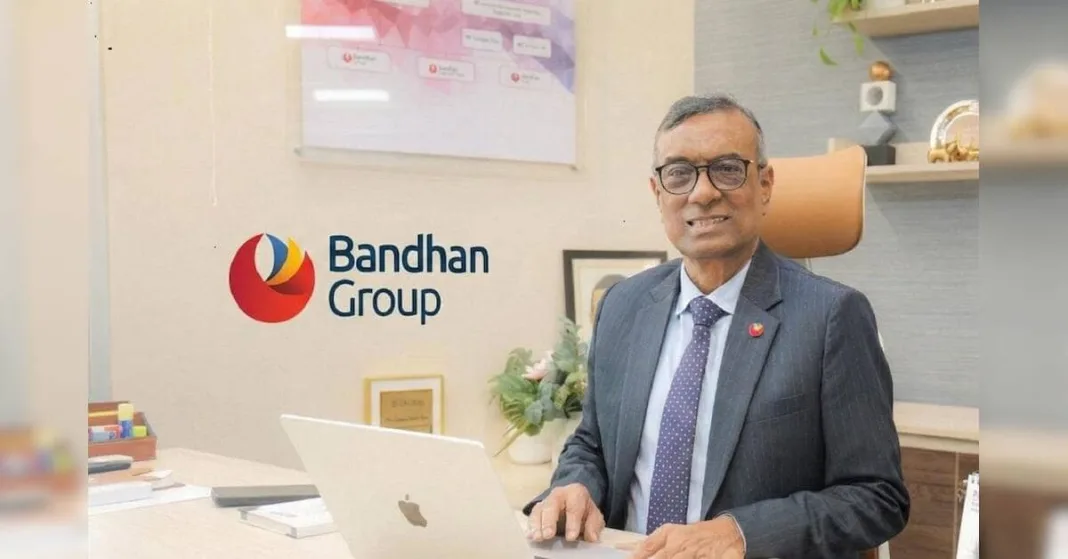

Chandra Shekhar Ghosh, founder and former managing director (MD) and chief executive officer (CEO) of Bandhan Bank, reflects on his 25-year journey and the way forward for the group in an interview with Krity Ambey and Asit Ranjan Mishra in New Delhi. Edited excerpts:
Did the shift from a microfinance institution to a universal bank create a structural mismatch between Bandhan’s high-yield, relationship-intensive lending and the lower-risk, diversified business expected of a bank? If you could revisit the decision, would you still seek a universal banking licence today?
I learnt as an NGO (non-governmental organisation) worker that the poorest people are unreached by the formal financial system. To reach them, you have to think out of the box. But once we began serving them in groups, we realised a formal structure is essential, otherwise you cannot sustain these services. Rural families can build their own homes, but that does not turn a home into a five star hotel. To build something on that scale, you need a bank. A bank also gives us the risk-mitigation structure we need, and a universal bank cannot be a niche player in one small business. If we had not become a bank, we could not have been this inclusive. Bringing a bank to poor women is a major success. As these women grow their businesses, they need other products too, such as affordable housing, and we are happy to provide them.
The sector’s over-indebtedness crisis raises the question of whether microfinance lenders lent beyond what borrowers could repay. What would you change?
I can speak from the industry perspective. People need these services. If we do not provide them, they go to moneylenders who charge 5 per cent a month. If you make the process complex, a person who needs ₹50,000 will go to the moneylender, not to you. Microcredit is business credit, not a personal loan. Digital lending that ignores a borrower’s business capacity and relies only on a credit check is a personal loan. You must assess capacity, observe how the money is used, and then it returns. The lender, not the regulator, decides how much risk to take. That requires physical visits before and after lending, and group meetings. We lend to women because we want them to become entrepreneurs. As the industry grows, it must be careful not to lose sight of its objective.
Is the scope for digital tools in microfinance limited, especially for risk assessment?
Digital can help in a few ways. About 60 per cent of customers already have credit histories, so their data can be checked with credit bureaus. The other 40 per cent are new to credit. Loan paperwork and collection can also go digital. But the group meeting must continue. If payments go digital, customers stop attending meetings after a few weeks, saying they have already paid. When Covid hit, many urged me to move to a digital model. Microcredit is a physical model, and changing a model practised for 25 to 30 years overnight, without testing, could have cost us everything. We start with a minimum amount relative to the customer’s capacity to build credit discipline, then raise it by only 10 to 20 per cent a year. Digital data alone is not good enough to assess these customers.
Could your tech company eventually build tools to ease underwriting?
I cannot comment on 20 years from now. Ten years ago, a woman was selling tea on the street as a microcredit customer. Today she owns a restaurant with five people working under her, and her husband, a taxi driver, works under her management. Life changes, and needs will decide where technology goes. One clear opportunity today is voice-to-text. Staff ask a list of questions and the answers go straight into the loan application. It is easy, and I am still learning.
Secured lending is said to be around 57 per cent of your portfolio. How does the bank keep its identity as a financial inclusion institution as the share of microfinance shrinks?
I am not operationally involved in the bank. Strategically, our holding company sets the values and objectives, but the bank decides its own policies. Under the regulatory definition, our loans are unsecured, but they are business loans, not personal or consumption loans. No other lender’s staff meet customers 50 times a year. Even on secured housing loans, bankers usually visit only before disbursal and on default. Because it is depositors’ money, the bank will independently decide its risk-mitigation policy, now or in future.
You stepped down as MD more than two years ago and are now group chair. Are asset management, life insurance and tech your priorities now?
Yes, a bigger priority. I built up the bank and ran it for nine years. It should now run systematically. In tech, we have subsidiaries in the US, UK and India, and have recently opened one in Dubai.
How do you allocate capital across the group, and are there plans for other financial businesses or a listing?
Mutual funds do not need capital. Insurance does. Under regulation, the holding company reserves 25 per cent and can distribute 75 per cent as dividend. I have no plan for pensions, investment banking or wealth management. The challenge is the regulatory cap on expenses of management.
Banks are finding deposit mobilisation harder than lending. Could your recurring deposit model help?
When I opened the bank, customers put ₹20 or ₹50 into a recurring deposit every week, and once it reached ₹5,000, it automatically became a fixed deposit. People value the chance to save small amounts. The rural deposit market is big, and we have not captured much of it yet. I cannot recommend a strategy to the bank, but the need is there.
What is your strategy for the life insurance business?
Premium income has tripled in two years, from about ₹335 crore to ₹1,000 crore, so the opportunity is big. Health insurance is the bigger one. It brings immediate benefit to the whole family, while life insurance is long term. I am waiting for the government to allow composite licences.