

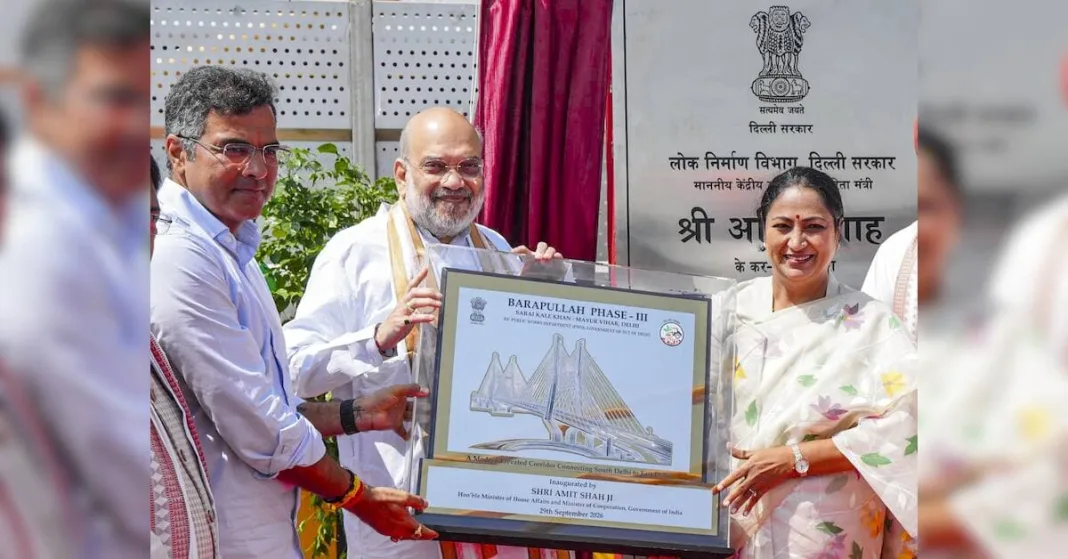

A day after it was opened, the Barapullah Phase-III elevated corridor, which took 12 years to complete, remained congested on Thursday.
The corridor, approved in 2014 to improve connectivity between east and south Delhi, remained heavily congested during Thursday’s morning and evening peaks, with traffic problems continuing through the day before police said the flow had normalised later in the evening.
Commuters faced long delays, queues for several kms
Traffic from Mayur Vihar Phase-I towards Sarai Kale Khan was particularly affected, with commuters reporting long delays and queues extending for several kilometres.
Some commuters, as reported by news agency PTI, were stuck for about 40 minutes, while another said it took 55 minutes to reach the first intersection of the flyover.
In a post on X, Delhi Traffic Police said that the congestion on the corridor had been “noted on priority” and that officers had been directed to increase regulation and deployment at critical merging and exit points.
The same day, traffic police also put up barricades at the entrance amid the congestion.
“There was traffic congestion for some time. We had advised commuters to use the DND or Akshardham route. However, with the barricades removed, traffic is now normal, and commuters are travelling without any hassle,” a senior traffic police officer told PTI.
“The carriageway from AIIMS towards Mayur Vihar was also opened on Thursday afternoon, facilitating movement of traffic on the newly opened corridor,” Public Works Department officials told the news agency.
Authorities identified major bottlenecks
After reports of severe snarls, the Delhi Traffic Police and PWD conducted a joint aerial survey on Thursday to examine traffic movement on the new corridor and nearby roads, Hindustan Times reported. The survey found problems at the merger near the Sundial at Sarai Kale Khan.
According to the report, the inspection found that traffic from multiple directions was converging into the existing Barapullah corridor, which has fewer lanes at the merging point. In some sections, two three-lane roads merge into a three-lane stretch.
Additional Commissioner of Police (Zone-II Traffic) Dinesh Kumar Gupta told Hindustan Times that three lanes of traffic were coming from Mayur Vihar, while another three lanes were merging from the Sundial loop. “Since the corridor itself is just three lanes, the merger leads to a deadlock where six lanes try to merge into three,” he said.
HT also reported that a lane on the loop near Sundial Park ends at an angle close to 90 degrees, creating another point of conflict between vehicles.
The newly opened corridor has also attracted vehicles that would otherwise have used NH-24 and the DND Flyway, increasing traffic on the existing Barapullah corridor, the inspection said, as reported by HT.
Changes to road layout under consideration
As per reports, the traffic police have taken up the merger issue with the agencies concerned and proposed changing the road geometry near Sundial. The proposal includes providing a smoother curve so that vehicles can merge more gradually.
Police have also asked PWD to place barricades at the problematic junction to alter the movement of vehicles. Traffic-control measures, including signals at selected merging points, are also under consideration, The New Indian Express reported.
Another measure is to update traffic and navigation information for the new corridor on Google Maps, it added.
Social media users react to traffic congestion
After the incident, people on social media slammed the authorities for what they described as mismanagement. “What will you solve for? The density is so high. By the time the projects launch, the demand has exceeded the supply,” a user said in a post on X.
Another user, posting a picture of the traffic jam, wrote, “A flyover built to save travel time… took 55 mins just to reach its first merge point. Barapullah Phase III is finally inaugurated for Traffic Jams. Years and crores spent. Reduce travel time – mission apparently loading.”
The Barapullah Phase-III corridor connects Mayur Vihar Phase-I with Sarai Kale Khan and joins the existing Barapullah network towards AIIMS. The project was intended to provide a signal-free route between east and south Delhi and reduce traffic pressure on routes such as DND and Akshardham.
(With inputs from agencies)