

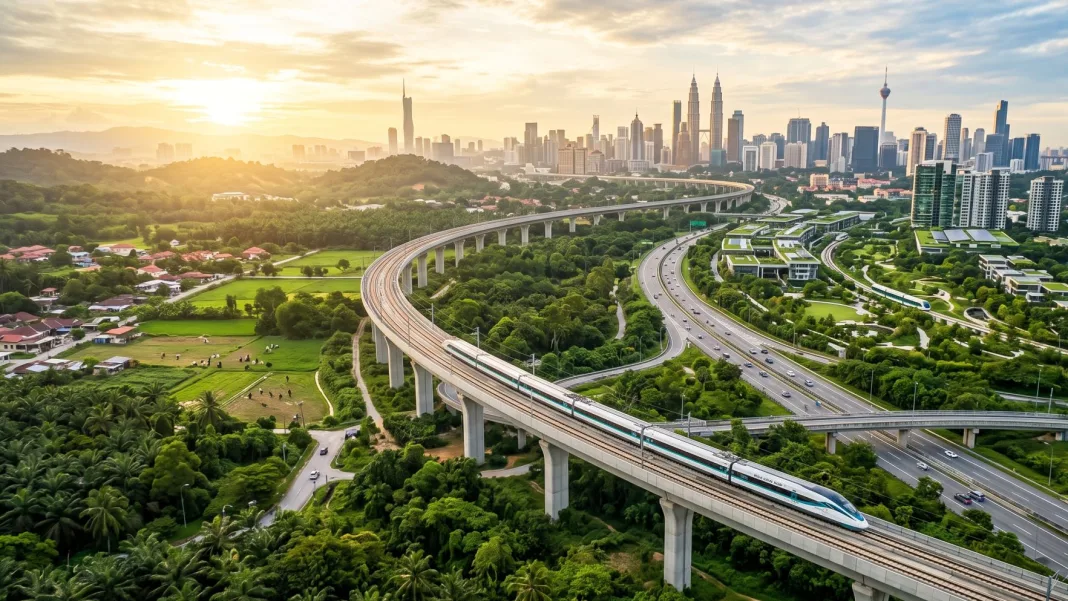

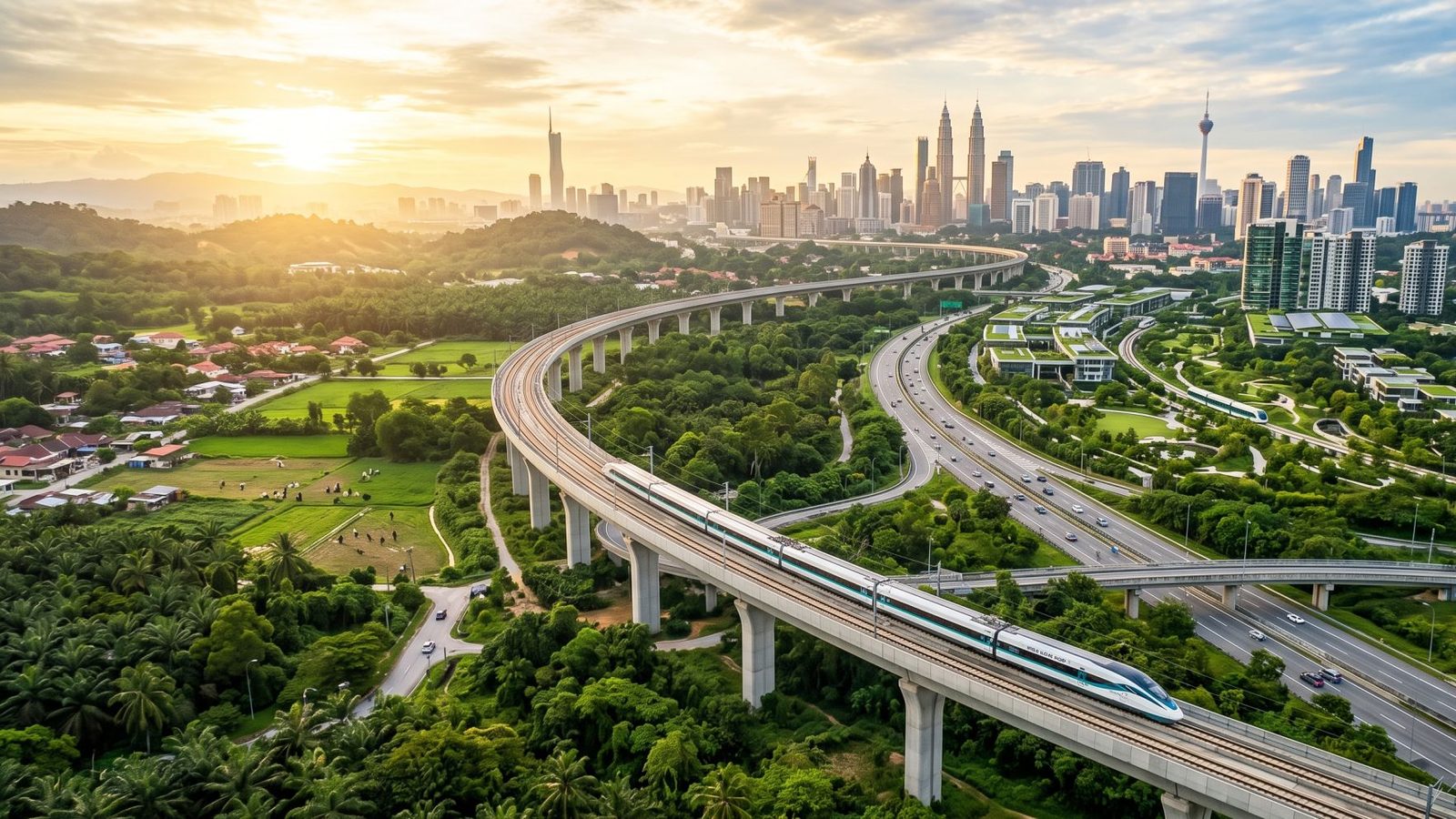
Image generated with Ai
Malaysia is accelerating its transformation through Malaysia infrastructure projects designed to create stronger transport links, modern cities and wider regional opportunities. The country’s latest infrastructure push matters because it connects economic centres, improves mobility and supports tourism and business growth.
From major rail networks to urban transport upgrades, Malaysia is building systems that can support future demand. Government-backed programmes under national development plans are reshaping how people travel, trade and connect across the country.
Malaysia is moving into a significant infrastructure development phase, supported by national planning priorities and large-scale transport investments. The government’s infrastructure strategy focuses on improving connectivity, strengthening logistics networks and supporting balanced growth between urban and regional areas.
The country’s infrastructure expansion is closely linked with the Thirteenth Malaysia Plan 2026–2030, which outlines national priorities for economic development, connectivity improvements and modern public facilities.
The Malaysian government views infrastructure as more than physical construction. It is a long-term platform to improve productivity, attract investment and create stronger connections between communities.
The Ministry of Finance has identified infrastructure development as a major element of national development planning, with transport, digital networks and regional connectivity remaining important investment areas.
The growing importance of Malaysia infrastructure projects reflects changing travel patterns, increasing urbanisation and the need for more efficient movement of passengers and goods.
Malaysia’s infrastructure expansion is being driven by several economic and social requirements. Rapid urban growth has increased pressure on existing transport networks, while businesses require faster logistics systems to remain competitive.
The government’s approach focuses on creating connected economic corridors rather than isolated projects.
Major infrastructure developments are designed to:
- improve passenger movement;
- strengthen freight transportation;
- support industrial development;
- encourage regional investment;
- enhance tourism accessibility.
The Ministry of Transport Malaysia identifies transport infrastructure development as a key part of national mobility planning. Its ongoing projects include rail, urban transport and connectivity improvements across different regions.
This approach demonstrates why transport infrastructure in Malaysia is becoming central to economic planning. Better connectivity allows cities, towns and rural communities to participate more effectively in national growth.
Why Is ECRL Considered a Transformational Infrastructure Project?
The East Coast Rail Link (ECRL) is one of the most significant additions to Malaysia’s national transport network. The project is designed to connect the east coast states with the western economic corridor, creating a new passenger and freight railway connection across Peninsular Malaysia.
According to the Ministry of Transport Malaysia, the ECRL project is expected to be completed by the end of 2026. Malaysia Rail Link (MRL), the project owner, has stated that operations are planned from January 2027.
The railway will connect areas across:
- Kelantan;
- Terengganu;
- Pahang;
- Selangor.
The project will create stronger rail connectivity in Malaysia by linking communities, industrial areas and logistics centres.
The official ECRL project information highlights that the railway will improve travel efficiency between Kota Bharu and the Klang Valley, reducing journey times and supporting both passenger and freight movement.
The strategic importance of ECRL goes beyond transport. It is designed to encourage economic activity along the corridor by connecting towns, rural areas and commercial zones.
The Malaysian Investment Development Authority (MIDA) states that ECRL is expected to strengthen economic links between cities, towns and rural communities while supporting investment, employment and tourism opportunities.
The impact of ECRL extends beyond commuters. The railway is expected to influence tourism routes by making destinations along the east coast easier to access.
Cities and towns connected by the railway could benefit from improved visitor movement, stronger local businesses and increased commercial activity.
The east coast of Peninsular Malaysia has significant tourism resources, including coastal destinations, cultural attractions and natural landscapes. Improved railway access can create additional travel options for domestic and international visitors.
For businesses, the freight capability of ECRL provides a new logistics option. Industries located away from traditional western transport corridors may gain better access to ports and commercial centres.
The official ECRL project description highlights its role in connecting key locations, improving passenger experiences and supporting freight services.
This makes ECRL a major example of how Malaysia tourism infrastructure and economic infrastructure are becoming increasingly connected.
Malaysia’s infrastructure strategy is also focused on improving mobility inside major urban centres.
Kuala Lumpur and the surrounding Klang Valley region continue to experience increasing demand for efficient public transport. Urban rail expansion is therefore becoming a key part of creating future-ready cities in Malaysia.
The Ministry of Transport Malaysia lists several important urban rail developments, including MRT and LRT projects designed to improve city connectivity.
Urban rail investment supports several objectives:
- reducing dependence on private vehicles;
- improving commuting efficiency;
- connecting residential and employment areas;
- supporting sustainable urban growth.
Projects such as the MRT Putrajaya Line and LRT3 represent efforts to expand Malaysia’s metropolitan transport capacity.
The government’s focus on public transport reflects a wider global trend where cities are investing in efficient mobility systems to support growing populations.
The MRT Putrajaya Line represents one of Malaysia’s largest urban rail developments. The project strengthens connections between Putrajaya, Kuala Lumpur and surrounding areas.
The LRT3 project is also designed to improve connectivity across Selangor and Greater Kuala Lumpur.
These developments demonstrate how Malaysia is creating integrated transport networks rather than relying only on road expansion.
Better urban rail systems can support:
- business districts;
- educational areas;
- residential communities;
- tourism destinations.
As Malaysia prepares for future economic and tourism growth, these systems are expected to play an important role in managing increasing mobility demand.
The expansion of urban rail also supports the concept of transit-oriented development, where communities and businesses grow around accessible transport networks.
How Will Penang’s New Rail Network Support Future Development?
Penang is becoming another important focus area in Malaysia’s transport transformation. The proposed Penang Mutiara Light Rail Transit (LRT) project represents a major step towards improving urban mobility and creating a more connected island and mainland transport system.
The Malaysian government has identified the Penang Mutiara LRT as a strategic public transport development under national infrastructure planning. The project is expected to support urban connectivity, reduce transport pressure and encourage more efficient movement across Penang.
The importance of the project comes from Penang’s role as a major economic and tourism centre. The state is known for manufacturing industries, international business activity and heritage tourism.
Improved public transport can help connect:
- residential communities;
- commercial areas;
- industrial zones;
- visitor attractions.
The Thirteenth Malaysia Plan 2026–2030 highlights the importance of integrated transport networks and transit-oriented development as part of Malaysia’s future growth strategy.
The Penang Mutiara LRT demonstrates how transport infrastructure in Malaysia is expanding beyond Kuala Lumpur to support regional cities.
Why Is the RTS Link Important for Malaysia’s Regional Growth?
Johor is receiving major infrastructure attention because of its strategic location next to Singapore. The Johor Bahru–Singapore Rapid Transit System (RTS) Link is one of Malaysia’s most important cross-border transport developments.
The project is designed to improve movement between Johor Bahru and Singapore while strengthening connectivity within the Iskandar Malaysia economic region.
The Ministry of Transport Malaysia identifies the RTS Link as a major transport development supporting future cross-border mobility.
The current cross-border connection between Johor and Singapore experiences significant passenger movement, creating demand for more efficient transport solutions.
The RTS Link aims to provide:
- faster cross-border travel;
- improved public transport capacity;
- stronger economic links;
- better commuter experiences.
The project also supports Malaysia’s broader ambition to create connected economic zones. Better links between Johor and Singapore can encourage business activity, tourism movement and regional cooperation.
For travellers, improved connectivity can create smoother journeys between two important Southeast Asian destinations.
For businesses, the infrastructure creates opportunities by strengthening access to one of Asia’s major economic hubs.
The RTS Link reflects the wider direction of Malaysia infrastructure projects, where connectivity is being developed as a foundation for economic growth.
Why Is East Malaysia Receiving Major Infrastructure Investment?
Malaysia’s infrastructure development is not limited to Peninsular Malaysia. Sabah and Sarawak remain major priorities because the government aims to improve connectivity across the country.
The Pan Borneo Highway is among the largest road infrastructure programmes in East Malaysia. It is designed to improve movement between communities, economic areas and important regional centres.
The Thirteenth Malaysia Plan identifies balanced regional development as a key national objective. Infrastructure improvements in Sabah and Sarawak support this goal by improving access to essential services, economic opportunities and transportation networks.
East Malaysia faces unique infrastructure challenges because of:
- large geographic areas;
- dispersed communities;
- difficult terrain;
- longer travel distances.
Improved road connectivity can create stronger links between towns and rural areas.
The infrastructure upgrade also has importance for tourism. Sabah and Sarawak have major natural and cultural attractions, including rainforests, indigenous communities and adventure destinations.
Better roads can support tourism businesses by making remote locations easier to reach.
This highlights how Malaysia tourism infrastructure depends not only on airports and hotels but also on reliable ground connectivity.
How Are Airport Improvements Supporting Future Travel Demand?
Malaysia’s infrastructure expansion also includes aviation development. Airports remain critical gateways for international visitors, domestic travellers and business connections.
The Ministry of Transport Malaysia continues to oversee aviation infrastructure development as part of national transport planning.
Airport improvements are designed to support:
- increasing passenger demand;
- improved traveller experience;
- stronger regional connectivity;
- tourism growth.
The timing of these improvements is significant because Malaysia is preparing for increased tourism activity through national tourism initiatives, including Visit Malaysia 2026.
Modern aviation infrastructure supports destinations by improving accessibility. International visitors often depend on efficient airport systems before travelling to cities, islands and cultural destinations.
The relationship between airports, rail networks and highways is becoming increasingly important.
A visitor’s journey does not depend on one infrastructure asset. It depends on a connected system that links airports, cities, attractions and accommodation areas.
This integrated approach is a major feature of Malaysia’s future transport strategy.
Why Are Logistics Networks Becoming More Important?
Malaysia’s infrastructure strategy is strongly connected with trade and supply chains. As a manufacturing and export-oriented economy, the country requires efficient systems for moving goods.
Projects such as ECRL are designed partly to improve connections between inland areas and major ports.
The railway’s connection towards Port Klang is expected to strengthen links between production areas and maritime trade routes.
Malaysia’s logistics infrastructure supports important economic sectors including:
- manufacturing;
- electronics;
- international trade;
- industrial development.
Improved logistics networks can help businesses reduce transportation challenges and improve supply chain efficiency.
The government’s approach combines:
- rail transport;
- highways;
- ports;
- digital systems.
This integrated network supports Malaysia’s ambition to remain competitive in regional and international markets.
The development of logistics infrastructure also creates opportunities for tourism-related industries because better transport systems improve movement between destinations.
Why Is Malaysia Investing Beyond Transport Projects?
Malaysia’s infrastructure planning increasingly includes climate resilience. Flood mitigation projects are becoming important because extreme weather events can affect communities, businesses and transportation networks.
The Ministry of Finance Malaysia has highlighted flood mitigation and resilience-related infrastructure as part of national development priorities.
Flood protection projects aim to:
- protect communities;
- reduce infrastructure damage;
- improve urban resilience;
- support sustainable development.
Infrastructure investment is therefore expanding beyond roads and railways.
Modern infrastructure must also be able to withstand environmental challenges.
This approach supports the creation of future-ready cities in Malaysia, where urban systems are designed for long-term resilience.
How Is Technology Becoming Part of Infrastructure Development?
Malaysia’s infrastructure transformation includes digital connectivity alongside physical projects.
The government recognises that modern economies require strong digital systems, reliable utilities and connected communities.
Digital infrastructure supports:
- businesses;
- education;
- government services;
- tourism systems.
Smart cities increasingly depend on digital networks to improve services and efficiency.
The Thirteenth Malaysia Plan includes broader development priorities that support digital transformation and economic competitiveness.
For tourism, digital infrastructure can improve visitor experiences through online services, travel platforms and smarter destination management.
For businesses, better connectivity supports innovation and investment.
Malaysia’s infrastructure future therefore combines physical networks with digital capabilities.
Malaysia’s infrastructure expansion represents a long-term strategy focused on connectivity, competitiveness and balanced development.
The country is creating a network where railways, highways, airports, ports and digital systems work together.
The biggest transformation will come from stronger integration between regions.
ECRL will strengthen east-west connectivity. Urban rail projects will improve city movement. Johor’s RTS Link will enhance cross-border access. Sabah and Sarawak infrastructure programmes will support wider regional participation.
These developments demonstrate that Malaysia infrastructure projects are becoming important drivers of economic and tourism growth.
As infrastructure systems become more connected, Malaysia is positioning its cities and regions for future demand.
Malaysia’s infrastructure transformation shows how Malaysia infrastructure projects are creating stronger foundations for travel, business and regional growth. Major rail networks, urban transport systems, highways and digital upgrades are reshaping connectivity across the country.
Government initiatives such as ECRL, MRT expansion, RTS Link and regional infrastructure programmes demonstrate a long-term commitment to modern development. These investments support transport infrastructure in Malaysia, strengthen tourism access and encourage future-ready cities.



