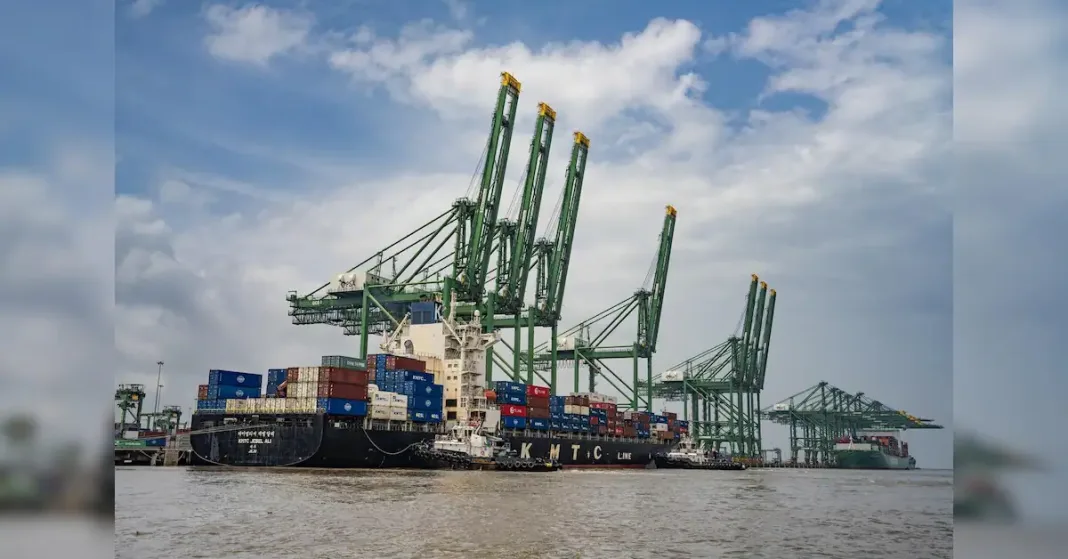

The shipment cost to the US has reportedly risen from about $1,500 before the US-Iran conflict to about $10,000 for a 40-foot container. Similarly, freight rates to the Gulf, Europe and East Africa have risen from about $300 to $4,000, $1,200 to $5,000 and $1,200 to $3,400 respectively. Even China-India shipments, on a route not directly affected by the West Asia conflict, have seen freight rates rise to almost $3,100. The rise in transportation costs is pushing up landed costs by an estimated 10-15 per cent for many imports and exports. Besides eroding profitability, higher freight costs are constraining working capital, while longer waiting and transit times add to the woes.
A principal reason for the increase in freight rates is the uncertainty over safe passage of vessels through the Strait of Hormuz and the Red Sea. Major shipping lines such as Maersk have reduced services through conflict-affected areas and diverted vessels around the southern tip of Africa. They have also reduced vessel rotations and reallocated capacity. Meanwhile, a surge in exports from China has made ex-China freight rates quite attractive, encouraging shipping lines to prioritise Chinese ports, including for repositioning empty containers. The suspension by Mediterranean Shipping Company of some services to Indian ports has added pressure on other India-bound carriers, which are able to pass higher operating costs on to shippers amid the supply-demand imbalance. Meanwhile, bigger exporters are increasingly using 40-foot containers because the freight differential between 20-foot and 40-foot containers is only about 10-15 per cent.
The current disruption has revived familiar calls in India for freight subsidies and greater investment and incentives for building vessels, ports and containers. These demands, however, need to be considered against the background of the maritime industry undergoing a fundamental technological transition as it seeks to decarbonise international shipping in line with the International Maritime Organisation’s targets. A vessel ordered today may take two to three years to build and remain in service for decades, while fuel technology, environmental regulations and the economics of different propulsion systems could change substantially during its lifetime. It is a classic investment dilemma: postponing new capacity risks future shortages, while investing heavily in the wrong technology could leave the assets commercially stranded.
Several large shipping lines have begun offering higher-priced, end-to-end transportation packages including allied services such as inland transportation and customs clearance. Shippers opting for these packages reportedly receive priority access to shipping space, while others face delays and uncertainty even where long-term contracts exist. If such practices disadvantage shippers who decline bundled services, they could raise their concerns and seek examination by the Competition Commission of India.
India needs enough export and import cargo volumes to attract sailings from global shipping lines. For that, Indian producers must become more globally competitive and increase their share of global shipping volumes. Shipping capacities travel to places where enough cargo is available to fill them. India should not attempt to solve a shipping-capacity problem by subsidising select sectors. The best solution is to generate sufficient two-way cargo volumes to make India commercially attractive to shipping lines.