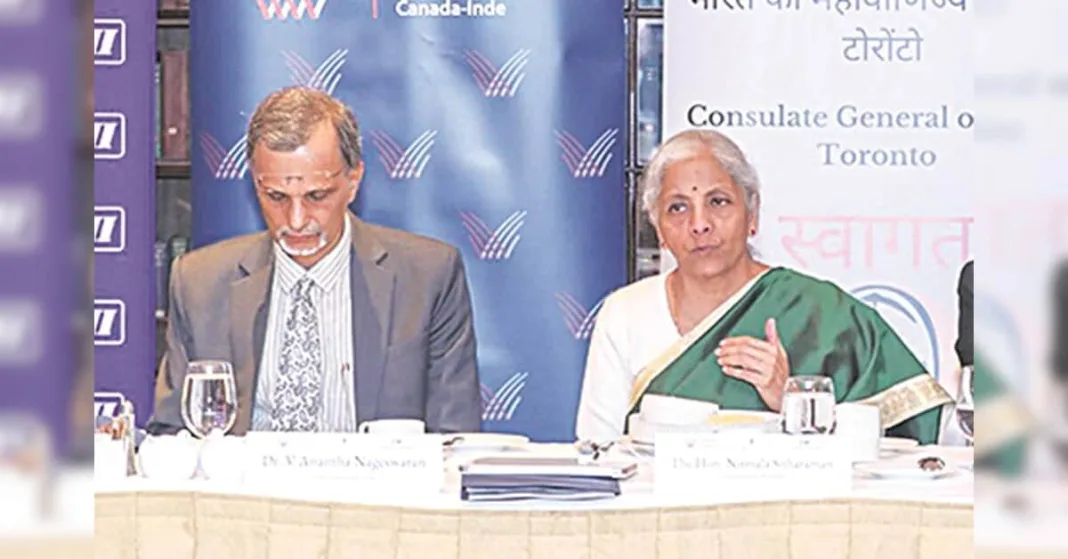

India and Canada can bring more predictability and certainty to the global growth at a time of severe global uncertainty, finance minister Nirmala Sitharaman said in Toronto while inaugurating the first bilateral Economic and Financial Dialogue on Thursday along with her Canadian counterpart François-Philippe Champagne.
“This is the best time to start this dialogue between Canada and India because global uncertainties being what they are and they seem to continue with severity, economies like Canada and India can bring so much more predictability and certainty to the global growth,” she said.
Addressing a joint press conference, both ministers reiterated their commitment to cooperating in various sectors including energy, infrastructure, finance, and the digital economy.
During her three-day visit to Toronto, Sitharaman met Canadian corporate leaders and investors, pitching cooperation and India as an investment destination across sectors ranging from infrastructure, renewable energy and financial services to critical minerals and artificial intelligence (AI). She said India and Canada aim to complete a foreign investment protection agreement (FIPA) by the end of this year. When Canadian Prime Minister Mark Carney visited India in March, the two countries also pledged to finalise a free trade agreement, or Comprehensive Economic Partnership Agreement, by the end of 2026.
Victor Thomas, President and chief executive officer of the Canada-India Business Council, told Business Standard that Sitharaman’s visit “builds real momentum in the relationship, lays the groundwork for a Comprehensive Economic Partnership Agreement, and paves the way for a bilateral visit by PM Narendra Modi to Canada later this year.”
NITI Aayog has estimated that India will need up to $6 trillion in foreign investment over the coming decades to meet its development and net-zero goals. During Carney’s visit, New Delhi signed a C$2.6 billion deal with Canadian company Cameco for the supply of 22 million pounds of uranium for nuclear energy generation from 2027 to 2035.
Speaking in Toronto, Sitharaman noted that Canadian pension funds have invested over $100 billion across various sectors in India and asserted that “India is probably the only country which is providing political and policy stability” for investors at this time.
Responding to a question from Business Standard about the Tamil Nadu government’s recent cancellation of the Parandur airport project near Chennai and the potential message it could send to foreign investors, Sitharaman said she had not yet been able to study the decision in detail “if it was final” and would comment on it back home.
Positioning India as a reliable business partner, she said: “We don’t want to become captive to somebody’s weaponising their investments or weaponising the economy. India has never had that kind of an approach to business.”
Her visit comes at a time when Canada finds itself in the midst of an escalating trade war with the US, by far its largest economic partner, with whom it has an annual bilateral trade relationship worth over $1 trillion. Bilateral goods and services trade between Indian and Canada currently stands around C$30 billion annually. The two countries aim to more than double this figure to C$70 billion by 2030.
Canada’s Finance Minister Champagne said: “We’re going to be strong at home and diversified abroad. So this is very much our diversification agenda in action. We’re uniquely complementary with India. We can be a very strategic partner to India when it comes to energy security, to food security.”
The revival of business and economic dialogue between India and Canada comes after a long freeze in bilateral relations. The previous Canadian PM, Justin Trudeau, had a contentious relationship with India due to his open support for the farmers’ protest in 2020 and his 2023 statement in the Canadian parliament accusing the Indian government of involvement in the murder of Canadian Sikh activist Hardeep Singh Nijjar.
Addressing business leaders in Toronto, Sitharaman said: “India-Canada bilateral relations have seen a remarkable transformation in recent times, underpinned by our shared values of democracy and pluralism and expanding economic engagement and the unprecedented pace of high-level interactions.”
The writer is a Toronto-based independent journalist