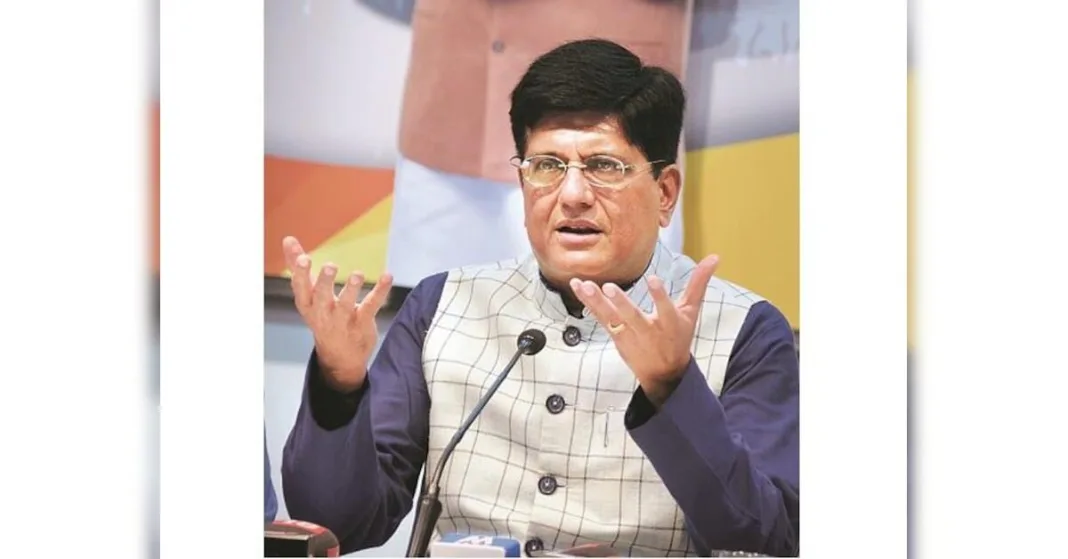

The government is planning a framework to exempt overseas companies looking to manufacture high-tech products in India from the Bureau of Indian Standards (BIS) certification requirement, Commerce Minister Piyush Goyal said in Tokyo on Tuesday.
“We have instructed BIS and all others in the Ministry of Commerce and Industry to work on a framework to support high-tech industries… (We’ve told them to) create a framework of exemption from BIS certification requirement for all the equipment and components they need to bring to India to promote their manufacturing in India,” Goyal, who is on a four-day visit to Japan, said.
The plan follows Japanese semiconductor manufacturer Tokyo Electron’s Corporate Officer and Executive Vice-President (Global Sales Division and India Business) Takeshi Okubo flagging concerns about BIS certification to Goyal on Monday.
The proposed framework is expected to help not just Japanese companies but all overseas firms looking to undertake high-tech manufacturing in India, Goyal said at a roundtable discussion on semiconductors and artificial intelligence (AI). “I believe this is a very logical step given that Tokyo Electron and other companies, which come in to make high-quality semiconductor products, are going to get high-quality products into the country,” Goyal said.
Tokyo Electron has collaborated with Tata Electronics to accelerate semiconductor equipment infrastructure in India. It has set up a commercial semiconductor fabrication plant (fab) in Dholera, Gujarat, and an outsourced semiconductor assembly and test (OSAT) facility in Jagiroad, Assam.
The Japanese firm has also partnered with other leading Indian information technology (IT) and engineering providers like HCL and Tata Consultancy Services (TCS) to build hardware and software capabilities. “We will be creating a framework which will either give company-level or industry-level exemptions. We will work on the framework as I get back to India and find a solution for bulk exemption or product- or project-based exemption or company-based exemption,” Goyal said.
The minister on Monday met executives from several other Japanese firms as well. These executives flagged the need for better social infrastructure around semiconductor manufacturing facilities in Dholera and Jagiroad. They also asked Goyal to ease regulatory compliance processes in India.
“We assure you that places like Dholera, Jagiroad and other areas where you are setting up operations will have reliable electricity, ultra-pure water, clean infrastructure, waste treatment facility, and high-quality logistics along with social infrastructure to make your journey in India faster and much more exciting,” Goyal said.
Japan is among India’s top five foreign direct investment (FDI) sources. According to the latest data available with the Department of Industry and Internal Trade (DPIIT), India has received cumulative FDI worth $48.14 billion from Japan as of March 2026 since 2000.