
Published on August 25, 2026 |

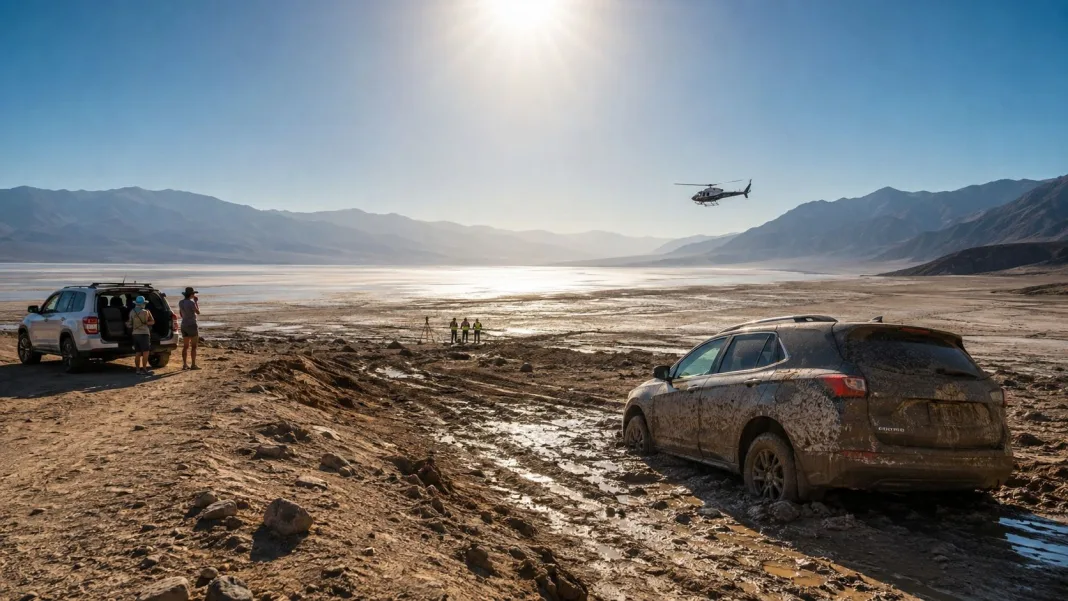
Image generated with Ai
The recent death of a 68-year-old French tourist who was stuck in Death Valley’s mud in 116°F heat has outlined the dangers of exploring California’s extreme desert landscape. Pierre Michel Formosa’s companion said that they were reaching temperatures of 46.6°C in the West Side Road when Formosa’s vehicle got stuck in the mud. Balancing his expedition with the risk of possible heat stroke, he and Formosa’s traveling companion attempted to reach civilization on foot. Formosa made about 2.09 kilometers before he succumbed to the extreme desert heat. Eventually, his companion was able to flag down a passing motorist to contact the authorities. It was not until several hours later that the sheriff’s department and park rangers found Formosa and declared him deceased.
French Tourist Dies During Extreme Heat
The fatal incident occurred on Monday, 17 August, as Formosa travelled through Death Valley National Park with his companion. Their vehicle became stuck in mud near Queen of Sheba Mine Road along remote West Side Road. The route sits far from the developed areas and visitor facilities that most tourists associate with Death Valley.
The pair decided to leave the vehicle and walk towards Badwater Road to seek assistance. They crossed the salt flats under exceptionally high temperatures, but the conditions soon became overwhelming. According to the National Park Service, Formosa could no longer continue after walking approximately 1.3 miles.
His companion continued towards the main road and eventually managed to attract the attention of a passing motorist. The driver helped report the emergency at the Furnace Creek Visitor Center shortly after 2pm. Rangers and an Inyo County deputy then began a search and rescue operation.
Advertisement
Advertisement
A California Highway Patrol helicopter also joined the search. Authorities eventually located Formosa approximately 1.5 miles from Badwater Road later that afternoon. The Inyo County coroner will determine the official cause and manner of death.
Death Valley National Park Superintendent Mike Reynolds described the incident as a stark reminder of the area’s dangers. “Death Valley is an extraordinary place, but its heat, distances, and remoteness can be dangerous, regardless of experience,” Reynolds said. His remarks underline why even experienced travellers can face rapidly changing circumstances in the park.
Death Valley Heat Leaves Little Margin
The Death Valley tourist death occurred during an exceptionally hot period across the American Southwest. Temperatures reached 116°F at the time of the incident, placing visitors under severe thermal stress. The National Park Service regularly warns that summer conditions can become life-threatening within a short period.
Death Valley holds the recognised record for the world’s highest recorded air temperature. Furnace Creek reached 134°F (57°C) on 10 July 1913, according to the National Park Service. The park also experiences some of the highest sustained summer temperatures found anywhere in the United States.
The geography helps explain the extreme conditions. Death Valley sits within a deep basin surrounded by mountains, while much of its floor lies below sea level. Badwater Basin reaches 282 feet below sea level, making it the lowest point in North America.
The valley’s geography also affects how heat behaves. Sunlight intensely warms the desert floor, while surrounding mountains restrict air movement. As a result, temperatures can remain dangerously high even after the sun begins to fall.
| Death Valley Heat Indicator | Recorded Figure |
|---|---|
| Highest recorded air temperature | 134°F / 57°C |
| Date of temperature record | 10 July 1913 |
| Badwater Basin elevation | 282ft / 86m below sea level |
| 2024 average summer high | 117.3°F / 47.3°C |
| Days above 120°F in 2024 | 37 |
| Annual rainfall | About 2.15 inches / 54.6mm |
The National Park Service recorded an average summer high of 117.3°F in 2024. That same year produced 37 days when temperatures exceeded 120°F. These figures demonstrate why summer travel in Death Valley requires significantly more preparation than a typical national-park visit.
A Stranded Vehicle Can Offer Protection
The most important lesson for travellers concerns what to do when a vehicle becomes disabled. In many travel situations, walking towards assistance might appear sensible. In Death Valley, however, leaving a vehicle during extreme heat can create an even greater danger.
The National Park Service advises visitors to stay with their vehicle when it becomes disabled, whenever conditions permit. A vehicle provides shade and offers some protection from direct sunlight. It also creates a much larger and easier target for search teams than a person walking through vast desert terrain.
This guidance becomes especially important on remote roads. Death Valley covers more than three million acres, while mobile phone coverage remains limited or unavailable across substantial parts of the park. A stranded traveller may therefore have few immediate ways to contact emergency services.
The incident demonstrates how quickly an ordinary vehicle problem can become a survival situation. Once the vehicle became stuck, the extreme temperature transformed a transportation problem into a race against heat exposure. For visitors, that makes emergency preparation as important as route planning.
Remote Roads Create Additional Risks
West Side Road provides access to some of Death Valley’s remote landscapes, but travellers should not treat every desert route like a conventional tourist highway. Surface conditions can vary dramatically, particularly after rainfall or flash flooding. Mud can create traction problems even when surrounding terrain appears dry.
The National Park Service regularly updates road and area conditions because weather events can damage infrastructure and change access. Loose gravel, soft shoulders, washouts and flood damage can all complicate journeys through remote sections. Consequently, travellers should check official conditions immediately before setting out.
GPS navigation also requires caution. Digital maps can show a route without communicating the latest physical conditions on the ground. A road that appears perfectly accessible on a smartphone may be unsuitable for a particular vehicle.
| Potential Problem | Why It Matters in Death Valley | Recommended Response |
| Vehicle stuck in mud | Extreme heat can quickly make walking dangerous | Remain with vehicle where possible |
| Flat tyre | Remote roads may have little traffic | Carry appropriate emergency equipment |
| No mobile signal | Emergency calls may be impossible | Carry satellite communication equipment |
| Flash flooding | Roads can become damaged or impassable | Check official conditions |
| Extreme heat | Heat illness can develop rapidly | Limit exposure and remain hydrated |
| Long distances | Assistance may take time to arrive | Carry extra water and supplies |
The National Park Service recommends that visitors carry at least one gallon of water per person per day. Travellers entering remote areas should also carry additional emergency supplies rather than relying solely on the minimum daily requirement. This becomes particularly important when travelling away from developed visitor areas.
Summer Sightseeing Needs A New Strategy
Death Valley remains an important attraction for domestic and international tourism. Its salt flats, dunes, mountains and unusual geology provide experiences that few other destinations can replicate. However, summer visitors need to change how they approach sightseeing.
The National Park Service advises visitors to avoid strenuous activity at lower elevations during extreme heat. It also recommends remaining near air-conditioned environments whenever temperatures become particularly dangerous. Travellers should therefore build summer itineraries around short outdoor stops rather than prolonged hikes.
Early morning and later-day visits can reduce exposure, although visitors should never assume that temperatures become automatically safe after sunset. Death Valley can remain extraordinarily hot for hours after peak afternoon temperatures. Heat conditions should therefore determine the itinerary rather than the other way around.
Higher-elevation locations can sometimes provide cooler conditions than the valley floor. Nevertheless, visitors should still check current weather and road information before travelling. Conditions can change quickly, particularly when storms affect remote areas.
Why International Visitors Need Extra Planning
The latest Death Valley tourist death carries particular relevance for international tourism. Visitors arriving from Europe or other temperate climates may have limited experience with sustained temperatures above 110°F. Even experienced travellers can underestimate the physiological impact of intense desert heat.
Travel advisers and tour operators can reduce that risk through better pre-trip information. Itineraries should clearly explain distances, water requirements, emergency procedures and seasonal restrictions. They should also distinguish between developed visitor areas and remote backcountry routes.
The distinction matters because Death Valley does not operate like a compact tourist attraction. Its enormous size means that visitors can travel considerable distances without encountering another vehicle. That remoteness forms part of the destination’s appeal, but it also increases the consequences of mistakes.
Travel companies should therefore treat heat-risk communication as part of destination management. Clear warnings can help visitors make informed decisions before entering remote terrain. They can also prevent tourists from interpreting extreme-weather advisories as routine travel information.
Death Valley Compared With Other Desert Parks
Death Valley’s safety challenges resemble those found across other desert destinations, but its heat can reach particularly severe levels. The park’s enormous scale also means that a minor incident may become more serious before help arrives. Travellers should therefore avoid assuming that safety practices from other destinations automatically apply.
The Grand Canyon, for example, presents major summer heat risks but also involves steep elevation changes and strenuous trails. Joshua Tree National Park creates different challenges, including heat exposure, limited shade and long stretches between facilities. Mojave Desert travel similarly requires careful attention to fuel, water and navigation.
| Destination | Principal Summer Hazard | Key Traveller Consideration |
| Death Valley | Extreme heat and isolation | Water, vehicle reliability and communication |
| Grand Canyon | Heat and strenuous terrain | Start early and monitor exertion |
| Joshua Tree | Heat and limited shade | Restrict hiking during peak heat |
| Mojave Desert | Heat and remote roads | Carry fuel, water and navigation backups |
| Sahara regions | Heat and remoteness | Local expertise and reliable transport |
The comparison highlights an important tourism principle. Desert destinations require destination-specific safety planning, rather than generic holiday preparation. Travellers should understand the precise combination of climate, geography and infrastructure before entering unfamiliar terrain.
Extreme Heat Is Reshaping Travel Behaviour
The incident also comes amid increasingly prominent concerns about extreme heat across major tourist destinations. Heatwaves have affected parts of the United States this summer, while national parks have repeatedly warned visitors about dangerous conditions.
For the tourism industry, extreme heat increasingly influences when and how visitors travel. Attractions that traditionally rely on daytime sightseeing may need to encourage earlier visits, shorter outdoor exposure and greater use of shaded or air-conditioned facilities.
This trend extends beyond Death Valley. Mediterranean destinations, desert regions and other hot-weather tourism markets are also adapting to more frequent extreme-temperature events. Heat is becoming an increasingly important consideration in travel planning, insurance, destination marketing and visitor management.
Travel businesses can respond by making weather intelligence part of the booking journey. Visitors should receive clear seasonal guidance before they arrive rather than encountering warnings only after reaching the destination.
Practical Safety Advice For Travellers
Visitors planning a summer trip to Death Valley should begin with the official park information rather than relying solely on travel blogs or navigation applications. Road conditions, weather alerts and access restrictions can change quickly. Checking these details immediately before departure can prevent avoidable problems.
Water should remain the first priority. The National Park Service recommends at least one gallon per person each day, while travellers entering remote areas should carry additional supplies. Visitors should also ensure their vehicle has sufficient fuel and is suitable for the intended road.
Communication presents another important consideration. Mobile phone coverage is unreliable across parts of Death Valley, so travellers visiting remote locations should consider carrying a satellite communicator or emergency beacon. They should also tell another person their planned route and expected return time.
| Traveller Checklist | Recommended Action |
| Weather | Check official forecasts before departure |
| Road conditions | Confirm current National Park Service updates |
| Water | Carry at least one gallon per person daily |
| Vehicle | Check tyres, fuel and cooling system |
| Communication | Carry a satellite communication device |
| Route | Share plans with another person |
| Heat exposure | Avoid strenuous daytime activity |
| Breakdown | Stay with the vehicle whenever possible |
Heat illness requires immediate attention. Symptoms such as dizziness, nausea, headache, confusion or unusual weakness should never be dismissed during desert travel. Travellers should stop exertion, seek shade or air conditioning and take appropriate action before symptoms become severe.
Visitors should also resist the temptation to continue because a destination appears close on a map. In extreme heat, even a relatively short walk can become dangerous. The latest incident demonstrates how quickly that calculation can change.
Official Guidance Should Shape Every Visit
The National Park Service remains the most authoritative source for current Death Valley travel conditions. Visitors should consult official information before travelling, particularly during periods of extreme heat or after storms. This approach provides more reliable information than depending entirely on static travel content.
Death Valley National Park official website
The park’s official conditions page provides information about closures, road conditions and other restrictions. Travellers should check it immediately before entering remote areas because conditions can change after weather events. The same principle applies to emergency planning and route selection.
Death Valley National Park — Current Conditions
For tourism businesses, official information can also strengthen responsible destination communication. Tour operators can incorporate current safety information into itineraries and pre-arrival messages. That approach protects travellers while also supporting more sustainable visitor management.
Death Valley Beauty Demands Respect
The recent Death Valley tourist death is an important reminder that beauty brings risk. For Formosa, a trip became a deadly situation due to a mechanical issue that became exacerbated by extreme heat. Something travelers must learn is that they must prepare for the worst.
One thing that remains the same is that Death Valley still offers a great opportunity for people to experience the beauty of deserts. However, people must understand the heat and the distance and prepare accordingly. Anticipate getting stuck and bring enough supplies.
For the travel industry, they must understand that there is a bigger responsibility that they hold to ensure that their visitors understand what type of extreme weather they may face when visiting.
Death Valley offers a one-of-a-kind experience, but they must understand the limits of where they visit to maintain responsible travel.
Advertisement
Advertisement