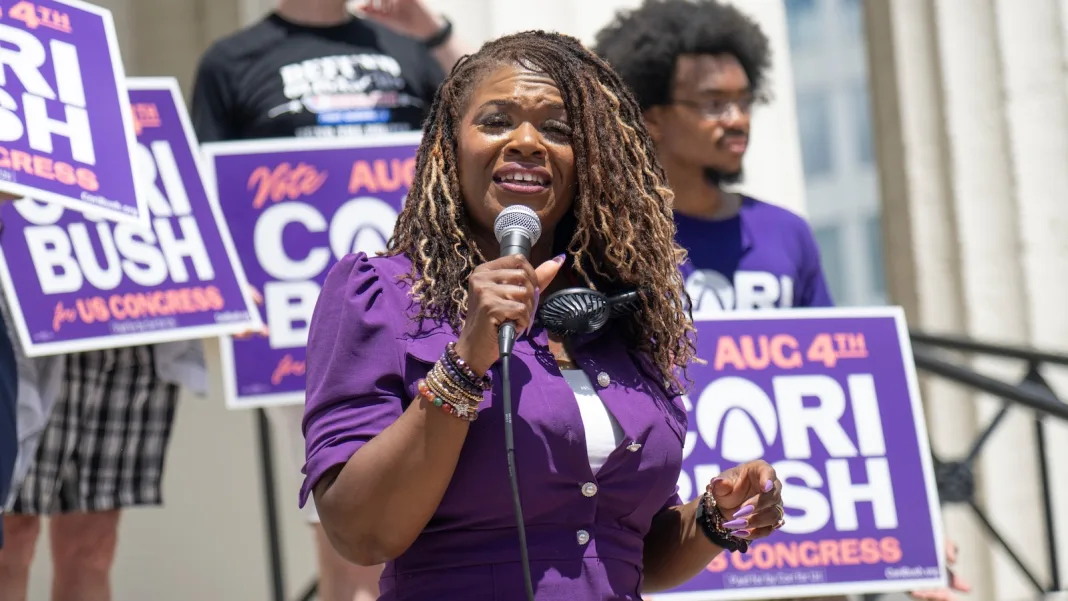

JEFFERSON CITY, Mo. — Former U.S. Rep. Cori Bush is attempting a political comeback Tuesday in a Missouri Democratic primary that tests evolving views on American-Israeli relations, just two years after the progressive “Squad” member was ousted by voters in favor of Wesley Bell.
The rematch in a heavily Democratic St. Louis district is one of several consequential primaries. In western Missouri, Republicans are picking a candidate to try to unseat Democratic Rep. Emanuel Cleaver in a dramatically reshaped district that is part of President Donald Trump’s attempt to retain a slim House majority in the midterms.
In northern Missouri, Republicans are choosing a potential successor to retiring Rep. Sam Graves, chair of the House Transportation and Infrastructure Committee.
Meanwhile, Missouri voters are deciding a pair of unique ballot measures backed by the Republican-led Legislature. One would require all citizen-initiated constitutional amendments to pass in each of Missouri’s eight congressional districts instead of by a simple statewide majority — a high standard used by no other state. The other would direct lawmakers to repeal the state’s individual income tax while authorizing a state sales tax expansion.
The contest between Bush and Bell tests how much the Democratic Party has shifted over the past two years.
The deep-pocketed American Israel Public Affairs Committee, which lobbies for U.S. support of Israel, spent millions to help oust Bush in 2024 after she criticized Israel’s response in Gaza to the 2023 Hamas attack on Israel. Bell is again supported by AIPAC.
But public opinions of Israel have since shifted, particularly among Democrats. A recent survey by The Associated Press-NORC Center for Public Affairs Research found that about 58% of Democrats now say the U.S. is “too supportive” of Israelis, up from 45% in an AP-NORC poll from January 2024.
This year’s primary also could test the growing clout of democratic socialists, who have traveled from across the country to help campaign for Bush.
Bush and Bell both honed their leadership skills in Ferguson amid the racial unrest that followed the fatal shooting of Michael Brown by a police officer in 2014. Bell won election to the Ferguson City Council the next year, then defeated a seven-term St. Louis County prosecutor in the 2018 Democratic primary.
Bush, a protest leader, defeated longtime Rep. William Lacy Clay in the 2020 Democratic primary. She served two terms before being defeated by Bell.
Missouri was the second Republican state, after Texas, to respond to Trump’s call last year to redraw congressional districts to the GOP’s advantage ahead of the midterms. The revamped map stretches Cleaver’s previous Kansas City district eastward into rural central Missouri, giving the new 5th District a Republican tilt.
Cleaver is unopposed for the Democratic nomination. A six-person Republican primary features state Sen. Rick Brattin, a Marine veteran and founding member of the Missouri Freedom Caucus, a conservative faction that has challenged the legislature’s GOP leadership. Brattin now has the backing of some of Missouri’s top Republicans, including Gov. Mike Kehoe.
His main advertising competitor has been Taylor Burks, a Navy officer who previously served as Boone County clerk, which oversees elections in the home county of the University of Missouri.
Graves, who has represented rural northern Missouri for a quarter century, set off a political scramble when he announced in late March that he wasn’t seeking reelection. He endorsed conservative talk radio host Chris Stigall, who once worked for Graves.
The five-person Republican field in the GOP-leaning 6th District also features Kansas City Council member Nathan Willett. The recent redistricting added more northern Kansas City neighborhoods to the sprawling district. The Democratic primary has three candidates.
A constitutional amendment placed on the ballot by Republican state lawmakers would make it harder for citizen-initiated amendments to win voter approval. The measure comes after voters narrowly passed several controversial citizen initiatives, including ones enshrining abortion rights into the state constitution, legalizing recreational marijuana, allowing sports betting and expanding Medicaid coverage to low-income adults.
None of those would have passed under the proposed requirement that citizen-initiated amendments win majority approval in every congressional district. Under Amendment 4, constitutional amendments proposed by the Legislature would still need just a statewide majority.
Amendment 5 would direct the Legislature to gradually eliminate the individual income tax as state revenue grows. It also would allow lawmakers to raise revenue by expanding the sales tax to “any goods and services” — giving them five years to decide which sales to tax without needing further voter approval.
The Missouri measure marks the first time since the modern income tax began over a century ago that a U.S. state legislature has asked voters whether to eliminate the tax. Alaska is the only state so far to impose a general individual income tax and then repeal it, doing so in 1980 by a legislative vote.
Massachusetts voters rejected income tax eliminations in 2002 and 2008 that were initiated by citizens, not lawmakers.