
Democrats are poised to finish several seats behind Republicans in 2026 in the nationwide race to redraw maps for the U.S. House. They can catch up in 2028, but only if they overcome a series of redistricting hurdles that the GOP does not face.
That’s because Democrats, in many states, can draw partisan political lines only if they evade constraints — some self-imposed — on their ability to counterpunch.
In Colorado, New Jersey, New York and Washington, redistricting commissions draw boundaries that are not supposed to benefit either party. Democrats will have to gain voters’ permission to nullify those politically popular bodies and replace their balanced maps with ruthlessly gerrymandered ones to match what Republicans did after President Donald Trump last year demanded a sweeping redrawing in Republican-controlled states in an attempt to help his party keep its House majority.
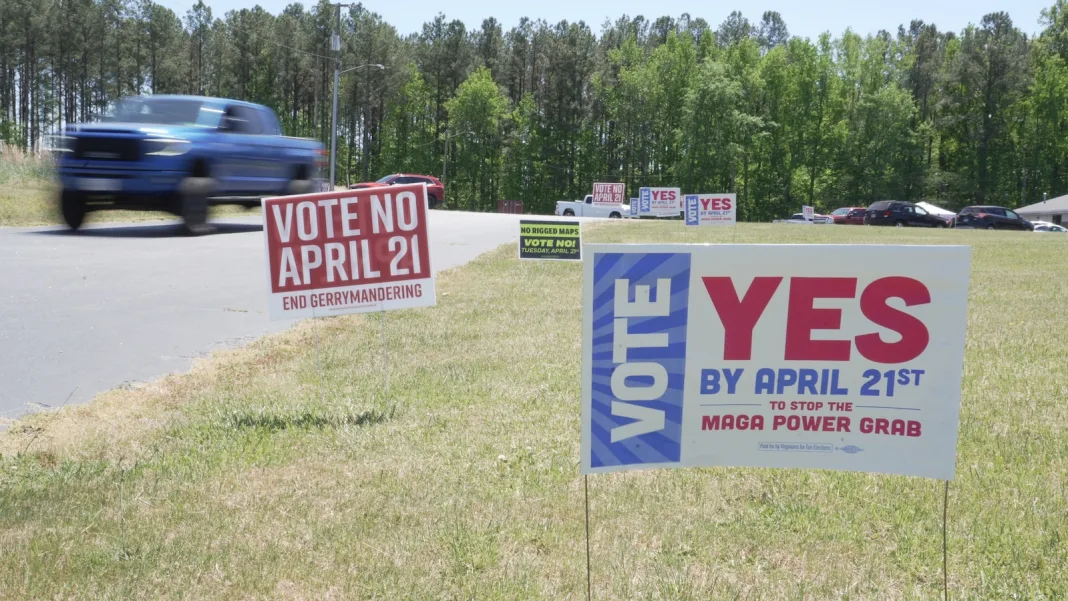
If the Democrats get a detail wrong in their process, courts could unwind the new maps. That is what happened in Virginia this month when the state Supreme Court invalidated voter-approved maps that would have given Democrats four more winnable seats. The court found the Democratic-controlled legislature did not follow the correct procedure when it placed the measure on the ballot.
“It’s going to be expensive, it’s going to be unpopular, and it’s going to be a challenge for them to do what they want,” said Adam Kincaid, executive director of the National Republican Redistricting Trust.
Democrats remain favored to win control of the House this year despite recent setbacks in redistricting. The most consequential was the conservative majority on the U.S. Supreme Court gutting a key provision of the Voting Rights Act, allowing Republicans to swiftly eliminate at least three majority-Black House seats in the South that Democrats now hold.
Strategists for both parties expect Democratic gains in November that are typical when the party of an incumbent president faces voter backlash in a midterm election. In Trump’s first midterm in 2018, for example, Democrats added 40 seats in the House.
But a 2028 House majority looks much harder for Democrats.
Presidential votes are usually much closer than midterm ones. Under the recent high court decision, Republicans next year could easily eliminate another five or more majority-minority Democratic-held districts in states whose maps were already set for 2026. They can likely gain an additional four seats by redrawing maps in Indiana, where some state lawmakers balked last year and were punished by Republican primary voters, and in Kentucky and Kansas, where Democratic governors who have been able to block Republican maps will reach their term limit.
The mapmaking pressure is high for Democrats to try to boost their chances of winning the House in 2028 as the party also hopes to take back the Senate and White House that year. Only then could it try again to pass a national ban on partisan gerrymandering that could rob the Republicans of what could become a durable advantage for them.
After the 2030 census, House seats will be reallocated to states seeing the fastest population gains, which are mainly ones that Republicans control. They are projected to pick up as many as 10 seats, largely at the expense of Democratic strongholds such as California and New York.
“Looking at the next census makes me all the more stressed to ban partisan gerrymandering at the federal level,” said John Bisogano, executive director of the National Democratic Redistricting Committee.
Republicans face some of their own legal hoops in the redistricting competition.
In Florida, their redrawn congressional map hinges on the conservative-majority state Supreme Court throwing out that state’s constitutional ban on partisan gerrymandering.
But Democrats face far more obstacles and need to execute a series of complex political maneuvers.
Only in Illinois and Oregon would Democrats have a chance to draw additional winnable seats without many impediments.
Among Colorado, New York and New Jersey, Democrats could rack up close to double-digit gains in House seats, but only if they likewise thread the needle to change their constitutions.
In Maryland, Democrats who balked at redrawing their map this year are moving to place a constitutional amendment on the November ballot that would give them permission to eliminate the state’s sole Republican House seat in 2028.
Democrats note that their voters have embraced the idea of ditching the reform approach they once favored to let their party match the redistricting by Trump and his fellow Republicans. The biggest success came in California, where a ballot measure to adopt a new map to pick up as many as five seats easily passed last year. Virginia’s map passed more narrowly, but Democrats there remain resolute about implementing the 10-1 map in 2028.
In Washington state, Democrats’ only chance to revise the constitution and redraw maps would be to win a two-thirds majority of the Legislature in November, a tall order. Because Democrats expect to do well in November, they re also hoping to win a handful of state legislative seats that would give them control of maps in states such as Minnesota, Pennsylvania and Wisconsin.
Wisconsin Democratic Party Chair Devin Remiker has floated new maps to let Democrats win up to six seats in a state where Republicans now hold six of the eight House districts. Such an aggressive move is necessary, he said, because of what Republicans are doing elsewhere.
“If we’ve learned anything, we’ve learned that when you know a knife fight is coming — bring a bazooka,” he said.
In other states, Democrats are confident their voters will be behind them.
“People in New York are pretty fired up given what they’ve seen around the country,” said U.S. Rep. Joe Morelle, a New York Democrat who is close to the top Democrat in the U.S. House, Hakeem Jeffries, also from New York.
But New York voters cannot enter the redistricting fight until next year because the state constitution will need to be amended by a statewide vote to permit it. That can happen only after the Democratic-controlled Legislature votes twice over two years to put the question on the ballot.
Likewise, Colorado Democrats embraced the idea of an independent commission redrawing lines in their state. Though many have had second thoughts, they cannot act until voters lift the commission’s map this fall and permit a Democratic redrawing for 2028.
Their proposed initiative faces a challenge at the state Supreme Court. Even if it is approved for the ballot, it could face a rival measure from Republicans to redraw the map to favor conservative candidates.
“Republicans are stealing votes of Americans all across the country, and Colorado voters will say: ‘Hey, you can’t do that,’” said Curtis Hubbard, a spokesman for Democrats pushing the Colorado redrawing.
Colorado is the most visible example of Democrats’ about-face on redistricting.
Republicans won control of numerous statehouses in the 2010 midterm election and used that to redraw maps across the country, giving them an edge in the U.S. House. Democrats responded by embracing nonpartisan redistricting, a push that reached its zenith in 2018 when Colorado Democrats rallied behind a measure creating such a body in their state.
Now, both candidates for the party’s nomination for governor support overruling the commission. Former Democratic President Barack Obama, who made redistricting reform a key pillar of his platform, has also had a change of heart, calling for aggressive map redrawing nationwide.
Nicholas Stephanopolous, a Harvard law professor, said it is clear that Democrats view Trump’s redistricting push as an existential threat.
“I think they’re going to move heaven and earth to respond,” he said.
___
Associated Press writer Scott Bauer in Madison, Wisconsin, contributed to this report.