
Published on
March 26, 2026

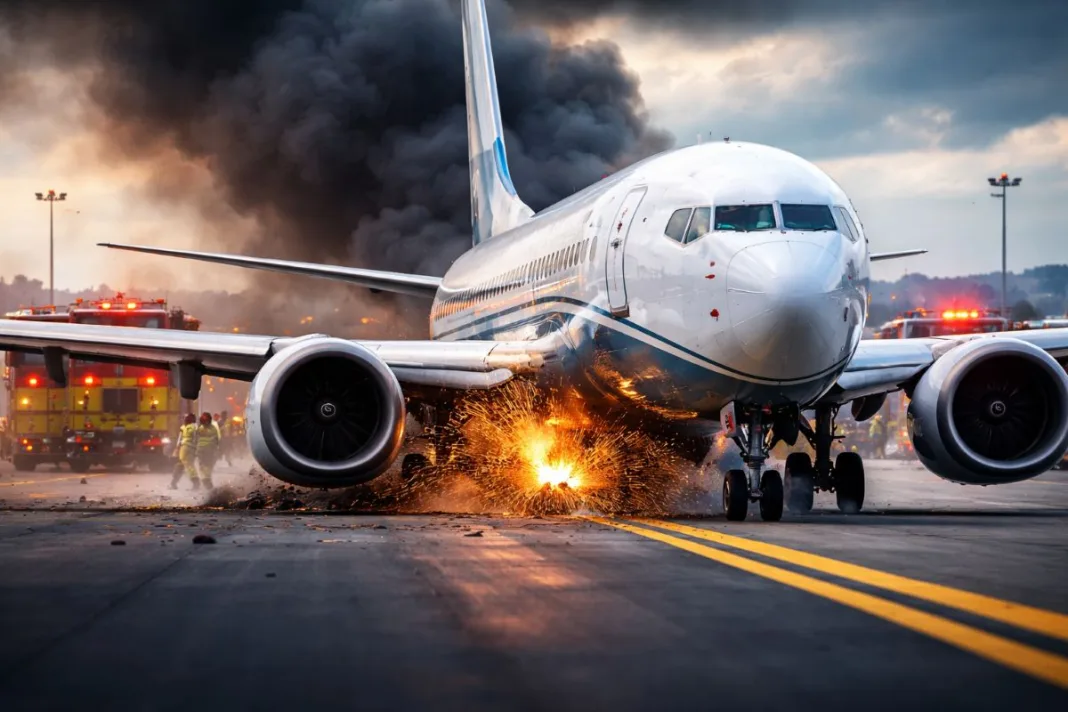
Image generated with Ai
A routine evening trip transformed into a scene of high-altitude anxiety for passengers aboard American Airlines Flight 1461 on Wednesday, March 25, 2026. The Boeing 737 MAX, traveling from Charlotte Douglas International Airport (CLT) to Newark Liberty International Airport (EWR), was forced into a dramatic emergency landing sequence after a nose-gear tire suffered a catastrophic failure. As the aircraft touched down in New Jersey, it was immediately greeted by a massive deployment of emergency first responders, locking down the runway as the smell of burning rubber filled the air.
Federal Aviation Administration (FAA) officials confirmed that the aircraft landed safely despite the mechanical compromise. While the incident triggered a full-scale emergency response, airport authorities and airline spokespeople have verified that no injuries occurred among the passengers or the flight crew. The aircraft remained on the taxiway for an extended period as technicians and safety inspectors evaluated the damage before the plane was cleared to be towed to the terminal gate.
The chronological sequence of the emergency involving American Airlines Flight 1461
Based on official reports from the FAA and airport authorities, here is the chronological sequence of the emergency involving American Airlines Flight 1461
- Departure from Charlotte (CLT): The Boeing 737 MAX departed Charlotte Douglas International Airport just before 7:00 PM on Wednesday, March 25, 2026, bound for Newark.
- In-Flight Mechanical Alert: During the flight’s progression toward the New York metropolitan area, the flight crew identified a mechanical issue involving the aircraft’s landing gear system.
- Emergency Declaration: As the plane approached its destination, the pilots declared an emergency to air traffic control, reporting a blown nose-gear tire. This status granted the aircraft priority landing rights.
- Strategic Landing at Newark (EWR): At approximately 9:00 PM, the aircraft touched down at Newark Liberty International Airport. Despite the shredded tire, the pilots utilized the secondary nose-gear tire to maintain directional control on the runway.
- Tarmac Interception: Immediately upon landing, the aircraft was swarmed by Port Authority emergency crews and fire engines as a standard safety precaution against potential friction fires.
- Runway Grounding: The aircraft came to a full stop on the taxiway/runway. Passengers remained on board while safety teams inspected the landing gear and checked the runway for debris (FOD).
- Successful Tow and Deplaning: Once the aircraft was deemed stable and the runway cleared, the Boeing 737 MAX was towed to the terminal gate, where all passengers and crew disembarked without injury.
- Maintenance Investigation: The aircraft was removed from service for a comprehensive inspection by American Airlines and federal oversight bodies to determine the cause of the tire failure.
The Critical Moment: High-Stakes Landing At EWR
The drama began to unfold as the flight approached the New York metropolitan airspace. According to data provided by aviation monitoring services and confirmed by FAA reports, the crew of the Boeing 737 MAX identified a pressurized system alert related to the landing gear. Specifically, the front nose tire—the wheel responsible for steering the massive jet once it hits the ground—had blown out.
Advertisement
Advertisement
Standard operating procedures for such a failure require the cockpit to declare an emergency to ensure they have priority for landing and that fire-rescue teams are positioned to intercept the plane the moment it makes contact with the pavement. At approximately 9:00 PM local time, the pilot executed a precision landing. Eyewitness accounts and localized reports from the Port Authority of New York and New Jersey indicated that the aircraft remained stable throughout its deceleration, a feat attributed to the dual-tire configuration of the 737’s nose gear, which allows a secondary tire to bear the load when its partner fails.
Massive Emergency Response Swarms The Tarmac
The visual scene at Newark Liberty International Airport was one of intense urgency. Photos and social media updates from the scene showed the Boeing 737 MAX stationary on the tarmac, surrounded by a ring of flashing red and blue lights. Fire engines and specialized rescue vehicles from the Port Authority Police Department (PAPD) stood by as a precaution against potential brake fires, which can occur when a shredded tire causes excessive friction or when pilots are forced to use heavy braking to compensate for the loss of steering control.
Advertisement
Advertisement
Initial assessments conducted on-site confirmed that the “blown” tire had effectively disintegrated, leaving the wheel assembly exposed. However, the integrity of the landing gear strut remained intact. Passengers were kept on the aircraft for a period while the primary runway was inspected for debris—known in the industry as Foreign Object Debris (FOD)—to ensure that no pieces of the shredded rubber would pose a risk to subsequent arriving or departing flights.
Safety Protocols And The Boeing 737 MAX
This incident puts a renewed focus on the Boeing 737 MAX, a model that has faced intense scrutiny over the past several years. However, aviation experts and government oversight bodies emphasize that tire blowouts, while dramatic, are part of the rigorous training every commercial pilot undergoes. The FAA’s safety manuals detail specific maneuvers for “asymmetric landing gear issues,” ensuring that the safety of the cabin remains the absolute priority.
Advertisement
Advertisement
According to National Transportation Safety Board (NTSB) guidelines, mechanical failures of this nature are typically investigated to determine if the cause was a manufacturing defect, a maintenance oversight, or external debris on the departure runway in Charlotte. American Airlines has stated they will conduct a comprehensive internal review of the maintenance logs for this specific airframe to determine the “root cause” of the tire’s failure.
Critical Case Study Analysis: American Airlines Flight 1461 Emergency Landing at Newark Liberty International Airport
On March 25, 2026, American Airlines Flight 1461, a Boeing 737, made a dramatic emergency landing at Newark Liberty International Airport (EWR) due to a mechanical issue involving a blown nose-gear tire. Despite the alarming nature of the incident, the aircraft was able to land safely with no injuries reported among the 160 passengers and crew. This case study explores the series of events surrounding the emergency landing, its implications for aviation safety, and the broader lessons the incident can provide for the industry.
Incident Overview:
- Date of Incident: March 25, 2026
- Aircraft: Boeing 737
- Flight Route: Charlotte Douglas International Airport (CLT) to Newark Liberty International Airport (EWR)
- Cause of Emergency: Blown nose-gear tire
- Outcome: Safe emergency landing with no reported injuries
- Flight Status: Departed from Charlotte at approximately 7:00 PM, landed safely at Newark shortly after 9:00 PM
- Passenger Status: No injuries; aircraft towed to gate post-landing
- Emergency Response: Fire trucks and emergency crews were on standby, as is customary in such situations.
Analysis:
- Mechanical Failure and Immediate Response:
- The core issue with Flight 1461 was the blown nose-gear tire, which could have resulted in serious consequences had the aircraft been unable to maintain control. A crucial safety feature in the Boeing 737 is the dual-tire configuration of the nose gear, which allowed the aircraft to land safely even after one tire failure. This redundancy in design likely played a significant role in preventing a more severe outcome.
- Upon discovering the issue, the flight crew immediately declared an emergency and followed standard operating procedures for such incidents. This included notifying air traffic control and ensuring that Newark’s emergency response teams were in place. The swift coordination of these elements contributed to the successful outcome.
- Emergency Response and Passenger Safety:
- Emergency crews were stationed at the airport to handle the potential risks associated with a blown tire, such as tire debris causing damage to the runway or the risk of fire from friction between the damaged tire and the runway.
- Thankfully, the emergency response proved to be effective, and no injuries were reported. However, it is crucial to consider the psychological toll that such an incident can take on passengers, especially given that blown tires, while rare, create a high level of uncertainty and anxiety.
- The plane remained on the tarmac for a period after landing, with passengers kept onboard as emergency services performed a thorough inspection of the aircraft. This decision ensured the safety of the passengers, although it led to some delays in deplaning. The quick rerouting of air traffic and the reassessment of airport operations helped minimize further disruptions.
- Broader Implications for Aviation Safety:
- This incident follows a series of tire-related mechanical failures that have gained attention in recent months. The increased scrutiny on aircraft maintenance procedures, particularly regarding tire safety, underscores a broader industry concern about mechanical failures during routine flights. While tire blowouts are relatively rare in modern aviation, the fact that such incidents are becoming more frequent suggests a need for more stringent tire inspection and maintenance practices.
- Aviation regulatory bodies like the Federal Aviation Administration (FAA) and the National Transportation Safety Board (NTSB) will likely conduct a detailed investigation into the cause of the blown tire. Factors such as tire wear, potential debris on the runway, and maintenance practices will be examined in-depth. This case study serves as a reminder of the importance of regular and rigorous maintenance schedules, particularly for high-utilization aircraft like the Boeing 737.
- Boeing 737 Design and Its Role in Crisis Management:
- The Boeing 737 MAX, the model involved in this incident, has faced significant scrutiny in the past due to software malfunctions and two fatal crashes in 2018 and 2019. While the blown tire in this incident is unrelated to the MAX’s previous issues, the aircraft’s design and how it handles emergencies continue to be a focal point in safety discussions.
- The aircraft’s dual nose-gear tires, which allowed for a controlled landing despite the blown tire, are an important feature that showcases the importance of redundancy in aircraft design. This feature likely mitigated the severity of the incident and contributed to the safe landing of Flight 1461.
- However, the increased public and media scrutiny of Boeing’s aircraft in the wake of previous incidents means that every failure, no matter how minor, will be analyzed under a magnifying glass. This requires airlines and manufacturers to demonstrate their commitment to maintaining the highest levels of safety and transparency.
- Passenger Experience and Industry Impact:
- While the incident had a positive resolution, the psychological and emotional impact on passengers should not be underestimated. Passengers aboard Flight 1461 likely experienced anxiety during the emergency landing, as the loud noise and vibrations from the blown tire would have created a heightened sense of urgency. The quick actions of the flight crew and the emergency responders helped ensure that the passengers felt safe and supported during the event.
- The impact on the broader aviation industry, particularly in terms of public perception, is significant. Passengers who have already witnessed high-profile incidents in recent years, such as the Boeing 737 MAX crashes, may feel apprehensive about flying on certain aircraft models. Therefore, it is essential for airlines, manufacturers, and regulatory bodies to communicate effectively with the public and reinforce the safety measures in place to prevent similar incidents.
- Investigation and Future Recommendations:
- The FAA and NTSB are expected to investigate the root cause of the blown tire. Factors like the tire’s age, maintenance history, environmental conditions, and any potential debris on the runway in Charlotte will be carefully analyzed. The results of this investigation may lead to updated recommendations for tire inspection, maintenance practices, and potentially modifications to the aircraft design or operational procedures.
- Going forward, it is critical for the aviation industry to enhance monitoring of tire conditions, particularly for high-frequency flights. Implementing more advanced tire health monitoring systems, as well as expanding training for pilots and ground crew, could help mitigate the risks associated with tire-related mechanical failures.
The emergency landing of American Airlines Flight 1461 highlights the complex nature of aviation safety and the crucial role of redundancy in aircraft design. While the blown tire on the Boeing 737 MAX was a serious issue, the timely response from the flight crew, emergency responders, and ground personnel ensured that the incident did not escalate into a catastrophe. However, this event serves as a reminder of the importance of rigorous maintenance practices, the need for continued investment in safety technologies, and the significance of transparent communication to maintain public confidence in the aviation industry.
This incident also reinforces the ongoing need for a comprehensive review of maintenance practices and safety protocols to address the rise of mechanical failures in the industry. As the investigation unfolds, the lessons learned from this case will likely shape the future of aviation safety.
The Passenger Experience: From Transit To Trauma
While the physical outcome was fortunate, the psychological toll on travelers cannot be understated. Passengers reported a “loud thud” followed by an unusual vibration as the plane slowed down. The transition from a standard travel experience to an emergency evacuation-ready environment often leads to significant stress.
Airport operations at Newark saw minor delays as the affected runway was temporarily shuttered for the tow operation. The Port Authority worked quickly to reroute traffic to other active strips, minimizing the ripple effect on the busy East Coast travel corridor. By late Wednesday night, the aircraft had been moved to a maintenance hangar, and passengers were finally able to deplane through the jet bridge and reunite with their families.
Investigating The Frequency Of Landing Gear Failures
Recent data from the Bureau of Transportation Statistics (BTS) suggests that while emergency landings are statistically rare compared to the millions of annual successful flights, tire-related incidents have seen a slight uptick in media visibility. Government-verified safety audits often point to the heavy utilization of narrow-body aircraft like the 737 MAX as a factor that requires vigilant tire pressure monitoring and frequent replacement cycles.
The FAA will be looking into whether the tire on Flight 1461 was a retread or a new component, and whether environmental factors—such as the heat in Charlotte or the cold tarmac in Newark—played any role in the structural failure. For now, the successful landing of Flight 1461 stands as a testament to pilot proficiency and the redundant safety systems built into modern commercial aviation.
The emergency landing of American Airlines Flight 1461 highlights the complex nature of aviation safety and the crucial role of redundancy in aircraft design. While the blown tire on the Boeing 737 MAX was a serious issue, the timely response from the flight crew, emergency responders, and ground personnel ensured that the incident did not escalate into a catastrophe. However, this event serves as a reminder of the importance of rigorous maintenance practices, the need for continued investment in safety technologies, and the significance of transparent communication to maintain public confidence in the aviation industry.
Advertisement
Advertisement