
Published on
March 26, 2026

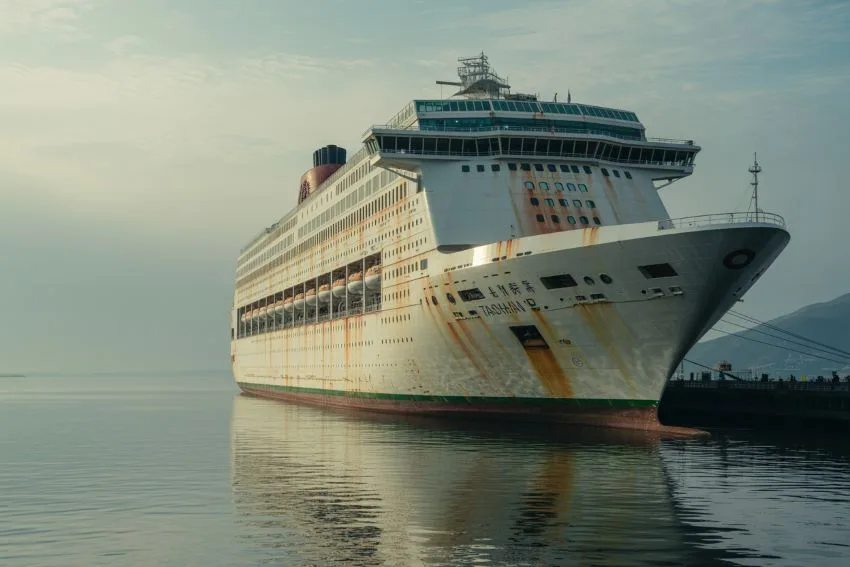
Image generated with Ai
Bohai Ferry Group has announced that it will publicly list for sale its cruise ship, the Chinese Taishan, with an asking price of $23 million. This will be the second time the vessel has hit the market, as Bohai Ferry Group has decided to withdraw from the cruise business for the time being. This news follows the board’s announcement on March 9, 2026, which will reflect the company’s restructuring.
Bohai Ferry Group’s Chinese Taishan cruise ship is notable for being the first cruise ship to be managed and operated by a Chinese company, and has since become a core component of the Chinese cruise industry. Chinese Taishan has a long history and has changed several names, ownerships, and even routes. With a sale price that is considerably lower than the previous purchase price, it can be expected that Bohai Ferry Group is looking to leave the cruise business for good and is looking to focus on its primary business of operating roll-on/roll-off (RoRo) passenger and freight transport.
Chinese Taishan’s Journey
When launched in 2000, Taishan was named Olympic Voyager and was operated by Royal Olympic Cruises. Since then, Taishan has changed ownership and names several times. After Royal Olympic Cruises, Taishan sailed with Iberocruceros as Grand Voyager. Most recently, she was branded as Costa Voyager before being acquired by Bohai Ferry.
Advertisement
Advertisement
In the beginning, she operated routes from Yantai, China, to South Korea and later moved to routes from Shanghai to Taiwan. She became a pillar in the Chinese cruise industry, operating domestic services and transporting thousands to and from major ports. Her cruise services ceased, and she was laid up in Dalian Port in 2020 as a result of the worldwide cruise industry shutdown from the COVID-19 pandemic.
Empowerment of Bohai Ferry from cruise to freight transport
Advertisement
Advertisement
Selling off the Taishan is in line with Bohai Ferry’s structural repositioning. The company continues to modernize by divesting its interest in cruising altogether, enabling it to concentrate on its core business of providing roll-on roll-off services to both passengers and freight. The spokesperson cited a lack of an ‘operating environment’ for crude domestic ship transport in China as a driving factor in the repositioning.
This is also a response to the wider re-adjustment in the maritime sector, vis-à-vis operating cruise businesses and the dry, prolonged pandemic spell globally affecting tourism. The cruise business, among the most adversely impacted, forced many of its players to adjust operational focus, pivoting instead to cargo and freight businesses, where demand remained buoyant.
Advertisement
Advertisement
Effect of Sale on Finances
Bohai Ferry made an investment of over forty million dollars when buying the Chinese Taishan from Costa Cruises. Now with an asking price of twenty-three million dollars, the loss from this sale is very clear. Still, the changes of strategy from Bohai Ferry demonstrate an effort to reconfigure the business to meet the demands of the market more efficiently.
An explanation for the low price of the sale is the difficulties that the domestic cruise market presents. It is also a reflection of the pandemic’s effect on the cruise market. The Chinese Taishan was one of the first cruise ships to be used in the fleet of China; however, today it represents an industry that is changing rapidly to cater to consumer demands and a very unpredictable market.
The Future of the Chinese Taishan
The Chinese Taishan is being advertised on the Dalian Property Rights Exchange and will thus be documented as a loss. If the prospects look positive, buyers from rival cruises or other sectors of the maritime industry may also be interested, as they may see an opportunity to revise the use of the Taishan. Not only is the recession limiting the sale of the Taishan, but the state of the global recession at present is also unfavorable.
For Bohai Ferry, the loss of Chinese Taishan will be the end of a business cycle, as they have sold one of the last Chinese cruise ships. Since divesting from cruise operations is also a sell signal for market players, it further demonstrates the market’s loss. The determination to divest the business of cruise operations demonstrates the desire to operate on more certain and lower-risk lines.
Wider Effects on the Industry
The loss of the Chinese Taishan will also affect other cruise lines, as it is also a record of the changing maritime environment. The pandemic restructured the markets of many companies, forcing a shift from carrying passengers to cargo and thereby more lucrative lines. This is not an exclusive case to Bohai Ferry, but a changing world for many cruise market players.
For passengers, the news about the sale of the Chinese Taishan is furthering the worry about the cruise industry. While some cruise companies have been able to rebound post pandemic, others are still continuously struggling with demand, as well as operational costs. It is clear there are still significant changes to come to the cruise industry as there are several uncertainties.
Conclusion: New Beginnings For Bohai Ferry
Bohai Ferry’s sale of the Chinese Taishan is a significant milestone in the company’s history. Stepping out of the cruise business, it is now the case that the company can strategically prioritise its core business of roll-on/roll-off transport. This is a clear sign that Bohai Ferry is trying to change, and now adapting to new market conditions will be vital to its business.
Chinese Taishan’s future is now in the hands of possible buyers. Whether she will come back to service as a cruise ship or will be reconfigured for other uses is still unknown. For now, Bohai Ferry’s decision reflects the continued difficulties faced by the global cruise industry as companies grapple with the realities of the world after the pandemic.
Advertisement
Advertisement