
Published on
March 23, 2026

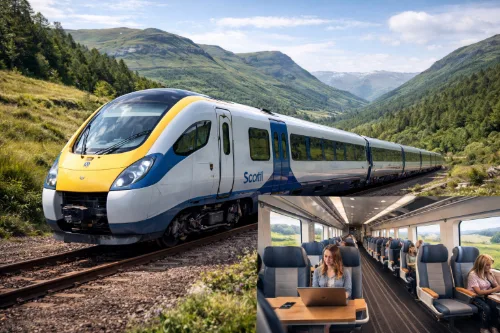
Image generated with Ai
On 19 March 2026, ScotRail unveiled one of the most significant overhauls in Scotland’s rail history — an ambitious plan to retire ageing high-speed trains (HSTs) and replace them with 22 newly refurbished Class 222 trains after an £80 million upgrade programme. This massive investment, supported by the Scottish Government, is reshaping intercity rail services across Scotland’s major cities and marking a new era of comfort, reliability, and modern connectivity for passengers.
Why the Shake-Up? Old HST Trains Reaching the End of the Line
ScotRail’s current fleet of High-Speed Trains (HSTs) — iconic diesel locomotives in service across routes from Glasgow to Edinburgh, Aberdeen, and Inverness — is increasingly considered outdated and expensive to operate. These trains have served travellers for years but now face rising maintenance costs and operational limitations that make them less sustainable and less efficient.
Officials stress that these older trains are reaching the end of their usable life, presenting operational challenges and higher costs while failing to meet modern passenger expectations. ScotRail’s decision to phase them out is seen as a future-focused solution to deliver improved service qualities and support Scotland’s ambitious transport goals.
Advertisement
Advertisement
The New Strategy: Class 222 Trains Take Centre Stage
At the heart of the transformation is the introduction of 22 five-car Class 222 diesel-multiple units (DMUs) sourced from Beacon Rail. These trains, previously operated in England, will undergo a comprehensive £80 million refurbishment programme before entering service with ScotRail.
Advertisement
Advertisement
The refurbishment will be handled by Alstom, a global rail manufacturer, in partnership with Beacon. The work aims to bring these trains up to modern passenger standards, including both exterior and interior enhancements — a move that will deliver tangible improvements in comfort, technology, and accessibility.
Inside the Refurbishment: What Passengers Can Expect
The sweeping £80 million overhaul is not just cosmetic. It’s a full-scale programme designed to transform the passenger experience on Scotland’s intercity routes. Key upgrades include:
- Brand-new interior design with comfortable seating and refreshed finishes.
- High-speed Wi-Fi connectivity via low-Earth-orbit satellite technology.
- Voice-over-Internet protocol (VoIP) phone capabilities onboard.
- Family-friendly spaces and enhanced luggage storage.
- Wheelchair access and improved accessibility across all carriages.
- USB-A and USB-C charging points at every seat.
- Onboard catering facilities for enhanced passenger comfort.
- Modern passenger information systems and CCTV for safety and real-time travel updates.
These improvements reflect a rail fleet built for a new era — one in which accessibility, connectivity, and comfort matter as much as speed and reliability.
Phased Roll-Out: Trains Arrive From Late 2027
ScotRail plans a phased introduction of the Class 222 trains, with the first units expected to enter service in late 2027. The remaining fleet will be rolled out progressively, with the final HSTs withdrawn from service by the end of 2028.
Before full deployment, six Class 222 units will be delivered early to support staff training. This training phase is crucial to ensure that drivers, conductors, and maintenance crews are fully prepared to operate the new fleet safely and efficiently as it is introduced across Scotland’s busiest intercity routes.
Transforming Scotland’s Rail Network and Daily Commutes
This fleet renewal project is not just about locomotives — it’s about drastically improving the daily travel experience for commuters and long-distance passengers alike. Scotland’s major cities, including Glasgow, Edinburgh, Aberdeen, and Inverness, will soon benefit from more reliable, comfortable, and connected rail services capable of encouraging more travellers to choose rail over road transport.
Transport leaders also believe this change will help reduce road traffic, cut emissions, and support Scotland’s broader decarbonisation goals by making rail travel more attractive to both business travellers and leisure passengers.
Government Support and Strategic Investment
A substantial portion of the refurbishment funding — approximately £67 million of the £80 million total — is being provided by the Scottish Government. This reflects a strategic commitment to modernise the nation’s rail infrastructure and deliver value for taxpayers by extending the life of proven rolling stock rather than building entirely new trains from scratch.
Officials highlight that this investment is not only enhancing passenger services but also contributing to local economies, rail supply chains, and job creation, particularly in maintenance, refurbishment, and support activities.
Industry Views: Why This Matters for UK Rail
Rail industry observers are calling ScotRail’s move pragmatic and forward-thinking. The decision to refurbish existing trains — rather than procure new ones — accelerates the delivery timeline and avoids long lead times associated with brand-new train builds. Experts note that the proven performance of Class 222 trains, combined with modern upgrades, strikes the right balance between reliability and innovation.
This strategy could set a precedent for other operators facing similar fleet renewal challenges across the UK and beyond — showing how refurbished assets can be repurposed cost-effectively with modern tech upgrades to meet evolving passenger expectations.
Beyond Trains: Technical Support and Maintenance Strategy
ScotRail has also secured a 10-year technical support and spares agreement with Alstom, valued at around £250 million. This long-term contract covers maintenance and supply of spare parts, ensuring the Class 222 fleet remains reliable and well-supported throughout its extended service life.
Maintenance activities will be carried out across ScotRail facilities, including crucial hubs such as Polmadie, Haymarket, and Inverness depots, supported by Alstom’s technicians and supply chain expertise. This arrangement highlights a collaborative approach between operator and manufacturer, underpinned by ongoing rail workforce training.