
Published on
March 2, 2026

Image generated with Ai
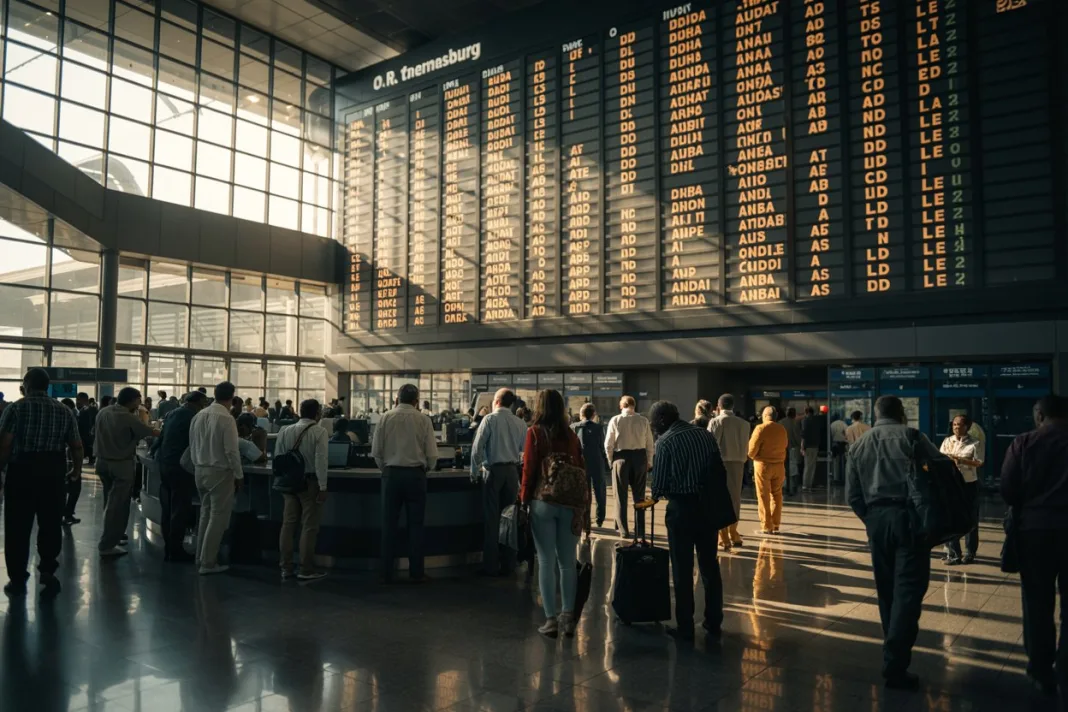
On Sunday, March 1, 2026, the quiet hum of South Africa’s major international airports was replaced by the frantic tapping of keyboards and the hushed, anxious conversations of thousands of travelers. As the geopolitical storm in the Middle East intensified, triggering widespread airspace closures over the UAE, Qatar, and Israel, the ripples reached the southern tip of Africa with undeniable force.
South African Tourism and the Airports Company South Africa (ACSA) have issued an urgent travel advisory, confirming that the “super-hub” connection between South Africa and the rest of the world has effectively been severed.
The Numbers: A Nation Grounded
The scale of the disruption is significant. At O.R. Tambo International (JNB) in Johannesburg—the continent’s busiest gateway—eight major flights were cancelled on Sunday alone, including seven outbound services. Cape Town International (CPT) recorded four outbound cancellations, while King Shaka International (DUR) in Durban saw two.
The primary cause? The total closure of the UAE and Qatari airspaces. This has effectively frozen the operations of Emirates and Qatar Airways, the two carriers that serve as the primary bridge for South Africans traveling to Europe, Asia, and the Americas.
Advertisement
Advertisement
A Message of “Ubuntu” in Uncertain Times
In a statement that humanized the technical chaos, Dr. Shamilla Chettiar, Acting CEO of South African Tourism, called on the industry to embody the spirit of Ubuntu.
“During this period of disruption, South African Tourism has no doubt that the tourism industry will ensure that affected travelers are supported,” Chettiar stated. “This collective care is a reflection of our humanity and reinforces South Africa’s reputation as a welcoming partner.”
Advertisement
Advertisement
For the traveler sitting on a suitcase in Johannesburg or Cape Town, this means more than just a refund. It’s about the hotel that extends a stay at a discounted rate, the airline staff who offer a clear explanation, and the travel agent who works through the night to find a rerouted path home.
DIRCO’s Difficult Reality: Evacuations “Impossible”
While those in South Africa face the frustration of cancelled holidays, the situation for South Africans currently in the Gulf is far more dire. Clayson Monyela, Head of Public Diplomacy at the Department of International Relations and Cooperation (DIRCO), issued a sobering update: evacuation is currently “impossible.”
Advertisement
Advertisement
“When countries are at war… the first thing they do is shut down the airspace,” Monyela explained. “If anything is up there, you shoot it down because you don’t know whether it’s a missile or an aeroplane.”
With approximately 18,000 South Africans registered in the UAE alone, the government is utilizing WhatsApp groups and digital missions to stay in contact. For now, the message to those abroad is simple: Stay indoors, stay vigilant, and wait for the skies to clear.
What Travelers Need to Do Now
If you are among the thousands affected by the Middle East travel crisis, the authorities have laid out a specific protocol:
- Do Not Head to the Airport: Unless you have received a confirmed update that your flight is operating, stay at your current location. Airports are currently at capacity.
- Check Airlines Directly: Emirates has allowed passengers booked within the next 72 hours to rebook for free within a 10-day window. Qatar Airways is providing updates every 24 hours.+1
- Verify Travel Insurance: Now is the time to check your policy’s “Force Majeure” or “Civil Unrest” clauses.
- Embassies and Consulates: If you are a South African citizen stranded abroad, ensure you are registered with the local mission to receive security alerts.
The Ripple Effect on the Economy
The disruption isn’t just a headache for tourists. The Gulf is a vital corridor for high-value exports and energy transit. Any prolonged closure of the Strait of Hormuz or UAE airspace could lead to a spike in fuel prices in South Africa by April 2026, further straining the local economy.
Conclusion: A Test of Resilience
The Middle East travel crisis of 2026 is a reminder of how fragile our global connectivity truly is. But as Dr. Chettiar noted, it is also a moment for the South African spirit to shine. Whether you are a stranded tourist in Durban or an expat sheltering in Dubai, the priority is safety over schedules.
The road ahead is “fluid,” but the commitment from South African authorities is firm: no traveler will be left to navigate this storm alone.