
Published on
February 1, 2026

Blue Origin, the space venture founded by Jeff Bezos, has taken a major step by deciding to temporarily halt its New Shepard space tourism venture for at least two years. This is a major shift from its original aim of commercial space tourism to the development of a human lunar lander, as it aims to accelerate the competition in NASA’s Artemis program by setting its sights on the Moon instead of celebrity space tourism.
The End of New Shepard’s Space Tourism Era
Since its debut in April 2015, the New Shepard rocket has been a trailblazer in commercial space tourism, offering suborbital flights to the edge of space. The 63-foot-tall, reusable rocket successfully completed 38 flights from West Texas, sending passengers approximately 107 kilometers (about 67 miles) above Earth’s surface into the edge of space. These flights offered passengers a few minutes of weightlessness and spectacular views of Earth, marking a significant milestone in the commercial space travel industry.
New Shepard’s legacy includes high-profile passengers, including celebrities such as pop star Katy Perry and Star Trek actor William Shatner. These celebrity passengers helped to generate significant media buzz and public interest in commercial space tourism. The New Shepard’s reusable rocket system also set a new standard for spaceflight technology, pioneering vertical landings on a concrete pad, a technique later refined for Blue Origin’s larger New Glenn rocket.
However, despite its success in achieving important technical milestones and attracting wealthy customers, New Shepard faced challenges in terms of frequency and competition. The rocket’s limited flight cadence, combined with the high cost of ticket sales, which ranged from $200,000 to $1 million per seat, meant that Blue Origin struggled to generate consistent revenue from its tourism program. In comparison to competitors like Virgin Galactic, which had a more frequent flight schedule, Blue Origin’s New Shepard program struggled to maintain momentum.
Redirecting Resources Toward the Moon
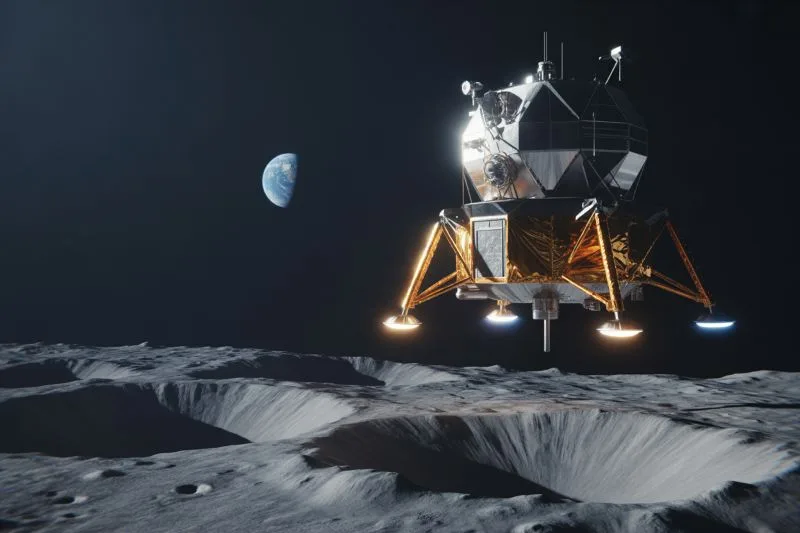
The decision to pause New Shepard’s space tourism program comes as part of a broader strategy to focus Blue Origin’s resources on more ambitious space projects. Specifically, the company will now direct its attention toward developing a human lunar lander for NASA’s Artemis program, with the goal of landing astronauts on the Moon later this decade.
Blue Origin’s involvement in the Artemis program is a significant milestone. The company secured a $3.6 billion contract with NASA to develop its Blue Moon lander, which will be capable of carrying astronauts to the lunar surface. This move represents a shift away from commercial space tourism and towards government-backed space exploration projects, which offer greater long-term returns and opportunities for innovation.
Advertisement
Advertisement
With the Artemis program aiming to establish a sustainable lunar presence and pave the way for further space exploration, Blue Origin is positioning itself as a key player in this new era of lunar exploration. The company will now focus on the technical challenges of landing astronauts on the Moon, with Blue Moon competing against SpaceX’s Starship in the race to become NASA’s primary contractor for lunar missions.
Impact on the Future of Space Tourism
The decision to pause the New Shepard program raises important questions about the future of space tourism and its economic viability. Although space tourism has generated immense public interest and media coverage, the industry faces growing challenges in terms of competition, cost, and sustainability.
Suborbital space tourism, while an exciting and glamorous experience, has proven to be less economically viable than orbital and lunar missions. The high cost of ticket sales and the relatively short duration of flights, combined with the technical and financial hurdles of launching and landing rockets, have made it difficult for companies like Blue Origin to maintain a steady flow of paying customers.
As space tourism continues to evolve, companies will likely need to explore new business models, focusing on a combination of government contracts, scientific missions, and private-sector partnerships. The financial success of space tourism may depend on securing long-term contracts with government agencies like NASA, as well as private partnerships with industries interested in space exploration, research, and technology development.
In the meantime, the pause in Blue Origin’s New Shepard flights will allow the company to focus on the development of more advanced space technology, such as its heavy-lift orbital rocket, New Glenn, and its lunar lander, Blue Moon. These projects are seen as more sustainable and financially promising in the long run, as they align with broader industry trends towards government-backed exploration and deeper space missions.
Space Tourism and Global Space Race Dynamics
Blue Origin’s decision reflects a broader shift in the space industry towards deep-space exploration. As private companies continue to push the boundaries of space technology, the focus is moving away from short-duration, suborbital flights for tourists and toward more ambitious missions, such as lunar landings and Mars exploration.
This shift also has implications for the global space race. While Blue Origin is positioning itself for the Moon, other space agencies and companies, such as SpaceX and the Indian Space Research Organisation (ISRO), are also advancing their lunar and deep-space ambitions. ISRO, for example, is planning its own lunar mission with Chandrayaan-4, which aims to land on the Moon’s South Pole, an area of significant scientific interest.
In this evolving landscape, space tourism has played an important role in funding innovation and driving public interest in space exploration. While the pause in New Shepard’s program may mark the end of one chapter in the space tourism industry, it is also the beginning of a new era of exploration, with space tourism likely to play a supporting role rather than a dominant one.
The Road Ahead: Lunar Ambitions and Beyond
The shift in Blue Origin’s focus towards lunar exploration and space travel is a new beginning for the organization and the space industry as a whole. Although the space tourism venture through New Shepard introduced the idea of space travel to the masses, the future of the organization lies in the Moon and the potential for a lasting impact is immense.
With the continued collaboration between private organizations and government bodies to explore the Moon and beyond, the future of space travel will be shaped by technological innovations and the dynamic economic landscape. The temporary halt in the tourism venture through New Shepard is a sign of the growth of the space industry, as commercial space travel will begin to support more long-term goals, including the establishment of human colonies on the Moon and the subsequent exploration of Mars.
In the end, although space tourism may take a temporary backseat, the innovations that will come out of these initiatives will pave the way for the next generation of space travelers and explorers.