


Published on
December 26, 2025

A Special Introduction: A Different Kind of Green
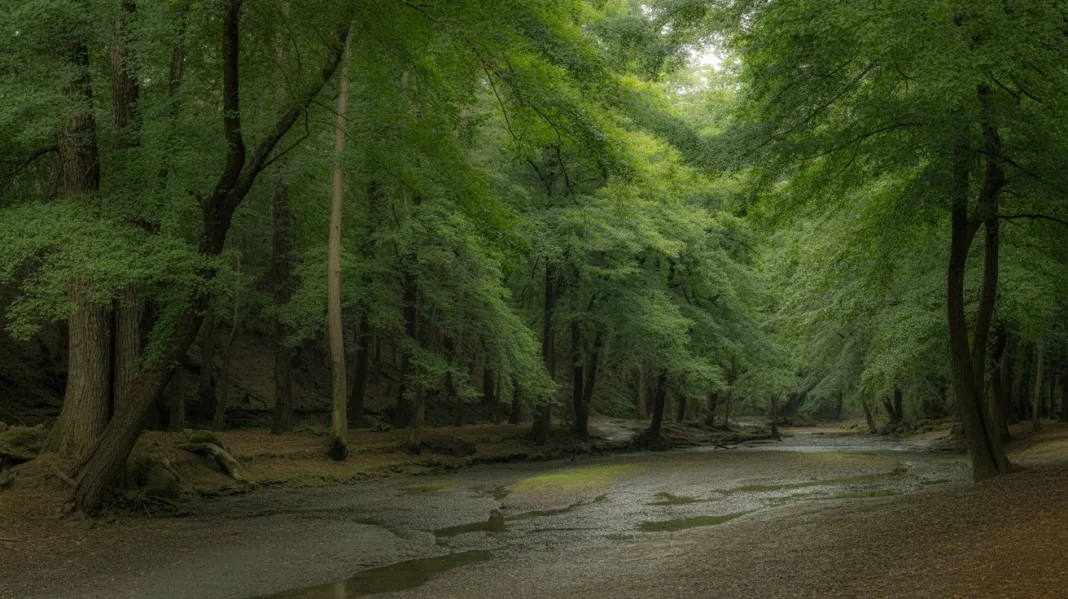
In a country often associated with mountains, plateaus, and semi-arid plains, the Samur Forest feels quietly unexpected. Located in Azerbaijan’s far north, near the border with Dagestan, this lowland forest unfolds not through elevation or drama, but through density, shade, and water. It is one of the country’s rare natural woodlands shaped primarily by rivers rather than altitude.
Here, greenery is not seasonal decoration—it is structural. The forest exists because the Samur River and its channels feed the land continuously, allowing trees, undergrowth, and wildlife to thrive where dryness might otherwise prevail. For travelers seeking a slower, softer landscape, Samur offers an immersive encounter with nature built on persistence rather than spectacle.
Geographic Setting Along the Samur River
Samur Forest stretches along the lower reaches of the Samur River near Azerbaijan’s northern frontier. The terrain is flat, humid, and fertile, shaped by flooding, sediment, and long-term water flow.
This geography supports dense vegetation rarely seen elsewhere in the country.
A Rare Lowland Forest Ecosystem
Unlike mountain forests, Samur’s woodland grows at low elevation. Broadleaf trees dominate, forming thick canopies that filter sunlight and retain moisture.
The result is a shaded, enclosed environment that feels distinctly different from Azerbaijan’s uplands.
Water as the Defining Force
Streams, channels, and wetlands thread through the forest, sustaining plant life and wildlife. Seasonal flooding replenishes soil nutrients, reinforcing ecological continuity.
Water here is not a feature—it is the foundation.
Soundscape of Shade and Movement
The forest absorbs sound. Wind moves softly through leaves, birds call from dense cover, and water flows quietly beneath vegetation.
Silence feels layered rather than empty.
Walking Through the Forest
Paths through Samur Forest are informal and often shaped by local use rather than design. Walking is slow, guided by ground conditions and vegetation density.
Movement encourages attentiveness.
Light, Canopy, and Atmosphere
Sunlight filters through overlapping leaves, creating dappled patterns that shift throughout the day. Visibility is limited, emphasizing proximity over distance.
The forest feels intimate and immersive.
Seasonal Rhythm Without Extremes
Samur Forest remains green longer than most regions. Seasonal change is subtle—variations in moisture, leaf density, and wildlife activity rather than dramatic color shifts.
Time here feels steady.
Wildlife and Biodiversity
The forest supports birds, small mammals, and insects adapted to wet, shaded environments. Wildlife presence is often sensed rather than seen.
Biodiversity thrives through concealment.
Human Presence at the Edges
Nearby villages interact with the forest carefully, using its resources while maintaining balance. Large-scale development is absent.
Human impact remains light and localized.
Samur Forest and Slow Nature Travel
This is not a place for itineraries or highlights. Samur rewards lingering, listening, and walking without a destination.
Slow travel aligns naturally with the forest’s pace.
Contrast with Azerbaijan’s Open Landscapes
Where much of Azerbaijan feels exposed and expansive, Samur feels enclosed and protective. The shift in spatial experience is immediate.
The forest offers refuge rather than revelation.
Environmental Importance and Fragility
As a rare ecosystem, Samur Forest requires protection. Its health depends on water flow, minimal disturbance, and long-term stewardship.
Respect ensures continuity.
Samur’s Place in Azerbaijan’s Natural Identity
Samur expands the country’s environmental narrative. It demonstrates that Azerbaijan’s diversity includes not only extremes but also balance.
Its quiet presence is essential.
A Special Conclusion: Where Shade Becomes Memory
Samur Forest does not overwhelm the senses—it gently absorbs them. After time beneath its canopy, travelers emerge with a softened awareness of space, sound, and movement. The experience lingers as a feeling rather than an image, defined by shade, moisture, and calm continuity.
In a travel world drawn to elevation and exposure, Samur offers the opposite lesson. It shows how nature can thrive through density and restraint, and how travel can be meaningful without dramatic moments. By walking slowly through Samur Forest, visitors are reminded that some landscapes do not seek attention—they sustain life quietly, and invite us to slow down enough to notice.